MCQ
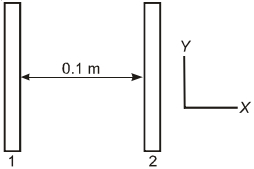
Two insulating plates are both uniformly charged in such a way that the potential difference between them is $V_2 - V_1 = 20\ V$. (i.e., plate $2$ is at a higher potential). The plates are separated by $d = 0.1\ m$ and can be treated as infinitely large. An electron is released from rest on the inner surface of plate $1. $ What is its speed when it hits plate $2?$
$(e = 1.6 \times 10^{-19}\ C, m_e= 9.11 \times 10^{-31}\ kg)$
  • A
    $32 \times 10^{-19} $ $m/s$
  • $2.65 \times 10^6 $ $m/s$
  • C
    $7.02 \times 10^{12}$ $ m/s$
  • D
    $1.87 \times 10^6 $ $m/s$

Answer

Correct option: B.
$2.65 \times 10^6 $ $m/s$
b
${e V=\frac{1}{2} m v^{2}}$

${\Rightarrow v=\sqrt{\frac{2 e V}{m}}=\sqrt{\frac{2 \times 1.6 \times 10^{-19} \times 20}{9.1 \times 10^{-31}}}}$

${=2.65 \times 10^{6} \,\mathrm{m} / \mathrm{s}}$

Need a full question paper?

Generate a complete, print-ready paper with questions like this in minutes — across 16+ boards, with answer keys.

Start Generating Free

Similar questions

A reflecting telescope has a large mirror as its objective with radius of curvature equal to $80\,cm$. The magnifying power of this telescope if eye piece used has a focal length of $1.6\, cm$ is 
An electric bulb rated $50 \mathrm{~W}-200 \mathrm{~V}$ is connected across a $100 \mathrm{~V}$ supply. The power dissipation of the bulb is :
The Wheatstone bridge shown in Fig. here, gets balanced when the carbon resistor used as $R_1$ has the colour code (Orange, Red, Brown). The resistors $R_2$ and $R_4$ are $80\, \Omega $ and $40\,\Omega $, respectively. Assuming that the colour code for the carbon resistors gives their accurate values, the colour code for the carbon resistor, used as $R_3$ would be
The principle of controlled chain reaction is used in
The force of viscosity is:
A printed page is seen through a glass slab place on it. The printed words appear raised. This is due to:
A hollow metallic sphere of radius $10 \;cm$ is charged such that potential of its surface is $80\; V$. The potential at the centre of the sphere would be
The position of the image formed by the combination of lenses is :

$\mathrm{f}_1=10 \mathrm{~cm} \quad \mathrm{f}_2=10 \quad \mathrm{f}_3=30 \mathrm{~cm}$

For a colour of light the wavelength for air is 6000 $\mathring A$ and in water the wavelength is 4500 $\mathring A$. Then the speed of light in water will be
Let $F_1$ be the frequency of second line of Lyman series and $F_2$ be the frequency of first line of Balmer series then frequency of first line of Lyman series is given by