MCQ
If an electron jumps from $1^{st}$ orbital to $3^{rd}$ orbital, then it will.
  • Absorb energy
  • B
    Release energy
  • C
    No gain of energy
  • D
    None of these

Answer

Correct option: A.
Absorb energy
a
(a) When an electron jumps from the orbit of lower energy $(n=1)$ to the orbit of higher energy $(n=3)$, energy is absorbed.

Need a full question paper?

Generate a complete, print-ready paper with questions like this in minutes — across 16+ boards, with answer keys.
Start Generating Free

Similar questions

The particles emitted by radioactive decay are deflected by magnetic field. The particles will be
$A$ $20\,volts$ $ac$ is applied to a circuit consisting of a resistance and a coil with negligible resistance. If the voltage across the resistance is $12\, V$, the voltage across the coil is.....$volts$
If a lens is moved towards the object from a distance of $40 \,cm$ to $30 \,cm$, the magnification of the image remains the same (numarically). The focal length of the lens is ......... $cm$
$n$ identical bulbs, each designed to draw a power $p$ from a certain voltage supply, are joined in series across that supply. The total power which they will draw is
The electric field in an electromagnetic wave is given by $\overrightarrow{\mathrm{E}}=\hat{\mathrm{i}} 40 \cos \omega\left(\mathrm{t}-\frac{\mathrm{z}}{\mathrm{c}}\right) N \mathrm{NC}^{-1}$. The magnetic field induction of this wave is (in SI unit):
Two resistances are connected in two gaps of a meter bridge. The balance point is $20\, cm$ from the zero end. A resistance of $15\, ohms$ is connected in series with the smaller of the two. The null point shifts to $40\, cm$. The value of the smaller resistance in $ohms$ is
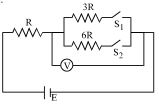
In the circuit shown in figure reading of voltmeter is $V_1$ when only $S_1$ is closed, reading of voltmeter is $V_2$ when only $S_2$ is closed. The reading of voltmeter is $V_3$ when both $S_1$ and $S_2$ are closed then
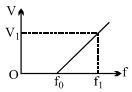
In a photoelectric experiment, the potential difference $V$ that must be maintained between the illuminated surface and the collector so as just to prevent any electron from reaching the collector is determined for different frequencies $f$ of the incident illumination. The graph obtained is shown. The maximum kinetic energy of the electrons emitted at frequency $f_1$ is 
In the nuclear decay given below 

$_z{X^A}{ \to _{z + 1}}{Y^A}{ \to _{z - 1}}{K^{A - 4}}{ \to _{z - 1}}{K^{A - 4}}$

the particles emitted in the sequence are

$1^{ H ^1}+1^{ H ^1}+1^{ H ^2} \rightarrow X +-1^{ e ^0}+$energy. The emitted particle is