If at temperature ${T_1} = 1000K,$ the wavelength is $1.4 \times {10^{ - 6}}m,$ then at ....... $K$ temperature the wavelength will be $2.8 \times {10^{ - 6}}m$
Easy


Download our appand get started for free
Experience the future of education. Simply download our apps or reach out to us for more information. Let's shape the future of learning together!No signup needed.*
Similar Questions
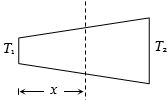
- 1Radius of a conductor increases uniformly from left end to right end as shown in fig.Material of the conductor is isotropic and its curved surface is thermally isolated from surrounding. Its ends are maintained at temperatures $T_1$ and $T_2$ ($T_1$ > $T_2$): If, in steady state, heat flow rate is equal to $H$ , then which of the following graphs is correctView Solution
- 2View SolutionWhen fluids are heated from the bottom, convection currents are produced because
- 3View SolutionCan we boil water inside the earth satellite by convection
- 4There is formation of layer of snow $x\,cm$ thick on water, when the temperature of air is $ - {\theta ^o}C$ (less than freezing point). The thickness of layer increases from $x$ to $y$ in the time $t$, then the value of $t$is given byView Solution
- 5View SolutionA piece of iron is heated in a flame. It first becomes dull red then becomes reddish yellow and finally turns to white hot. The correct explanation for the above observation is possible by using
- 6A copper pipe of length $10 \,m$ carries steam at temperature $110^{\circ} C$. The outer surface of the pipe is maintained at a temperature $10^{\circ} C$. The inner and outer radii of the pipe are $2 \,cm$ and $4 \,cm$, respectively. The thermal conductivity of copper is $0.38 kW / m /{ }^{\circ} C$. In the steady state, the rate at which heat flows radially outward through the pipe is closest to ............. $\,kW$View Solution
- 7The wall with a cavity consists of two layers of brick separated by a layer of air.All three layers have the same thickness and the thermal conductivity of the brick is much greater than that of air. The left layer is at a higher temperature than the right layer and steady state condition exists. Which of the following graphs predicts correctly the variation of temperature $T$ with distance $d$ inside the cavity?View Solution
- 8Two spheres of same material have radius $1m$ and $4 m$ and temperature $4000K$ and $2000K$ respectively. The energy radiated per second by the first sphere isView Solution
- 9A black body at a temperature of ${227^o}C$ radiates heat energy at the rate of $5 cal/cm^2-sec$. At a temperature of ${727^o}C$, the rate of heat radiated per unit area in $cal/cm^2$ will beView Solution
- 10Relation between emissivity $e$ and absorptive power $a$ is (for black body)View Solution