If average depth of an ocean is $4000 \mathrm{~m}$ and the bulk modulus of water is $2 \times 10^9 \mathrm{Nm}^{-2}$, then fractional compression $\frac{\Delta V}{V}$ of water at the bottom of ocean is $\alpha \times 10^{-2}$. The value of $\alpha$ is ___________(Given, $\mathrm{g}=10 \mathrm{~ms}^{-2}, \rho=1000 \mathrm{~kg} \mathrm{~m}^{-3}$ )
JEE MAIN 2024, Diffcult
Download our app for free and get started
$ \mathrm{B}=-\frac{\Delta \mathrm{P}}{\left(\frac{\Delta \mathrm{V}}{\mathrm{V}}\right)} $
$ -\left(\frac{\Delta \mathrm{V}}{\mathrm{V}}\right)=\frac{\rho \mathrm{gh}}{\mathrm{B}}=\frac{1000 \times 10 \times 4000}{2 \times 10^9} $
$ =2 \times 10^{-2}[-\mathrm{ve} \text { sign represent compression }]$

Download our appand get started for free
Experience the future of education. Simply download our apps or reach out to us for more information. Let's shape the future of learning together!No signup needed.*
Similar Questions
- 1A mild steel wire of length $2l$ meter cross-sectional area $A \;m ^2$ is fixed horizontally between two pillars. A small mass $m \;kg$ is suspended from the mid point of the wire. If extension in wire are within elastic limit. Then depression at the mid point of wire will be .............View Solution
- 2The ratio of Young's modulus of the material of two wires is $2 : 3.$ If the same stress is applied on both, then the ratio of elastic energy per unit volume will beView Solution
- 3A wire elongates by $l$ $mm$ when a load $W$ is hanged from it. If the wire goes over a pulley and two weights $W$ each are hung at the two ends, the elongation of the wire will be (in $mm$)View Solution
- 4View SolutionThere are two wire of same material and same length while the diameter of second wire is two times the diameter of first wire, then the ratio of extension produced in the wires by applying same load will be
- 5Two separate wires $A$ and $B$ are stretched by $2 \,mm$ and $4\, mm$ respectively, when they are subjected to a force of $2\, N$. Assume that both the wires are made up of same material and the radius of wire $B$ is 4 times that of the radius of wire $A$. The length of the wires $A$ and $B$ are in the ratio of $a : b$. Then $a / b$ can be expressed as $1 / x$ where $x$ isView Solution
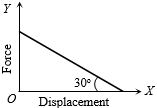
- 6The value of force constant between the applied elastic force $F$ and displacement will beView Solution
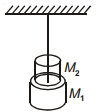
- 7The length of wire, when $M_1$ is hung from it, is $I_1$ and is $I_2$ with both $M_1$ and $M_2$ hanging. The natural length of wire is ........View Solution
- 8A rod of uniform cross-sectional area $A$ and length $L$ has a weight $W$. It is suspended vertically from a fixed support. If Young's modulus for rod is $Y$, then elongation produced in rod is ......View Solution

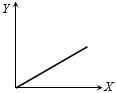
- 9A student plots a graph from his reading on the determination of Young’s modulus of a metal wire but forgets to label. The quantities on $X$ and $Y$ axes may be respectively.View Solution
- 10A $0.1 \mathrm{~kg}$ mass is suspended from a wire of negligible mass. The length of the wire is $1 \mathrm{~m}$ and its crosssectional area is $4.9 \times 10^{-7} \mathrm{~m}^2$. If the mass is pulled a little in the vertically downward direction and released, it performs simple harmonic motion of angular frequency $140 \ \mathrm{rad} \mathrm{s}^{-1}$. If the Young's modulus of the material of the wire is $\mathrm{n} \times 10^9 \mathrm{Nm}^{-2}$, the value of $\mathrm{n}$ isView Solution