Question
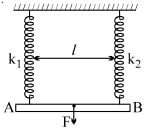
There are two wire of same material and same length while the diameter of second wire is two times the diameter of first wire, then the ratio of extension produced in the wires by applying same load will be
be. $Y.Y = \frac{{stress}}{{strain}} = \frac{F}{{A.\left( {\Delta L/L} \right)}},$
$F = applied\,force$
$A = \,area\,of\,cross - \,section\,of\,wire$
$Now,$
${Y_1} = {Y_2} \Rightarrow \frac{{FL}}{{\left( {{A_1}} \right)\left( {\Delta {L_1}} \right)}} = \frac{{FL}}{{\left( {{A_2}} \right)\left( {\Delta {L_2}} \right)}}$
Since load and length are same for both
$ \Rightarrow r_1^2\Delta {L_1} = r_2^2\Delta {L_2},$
$\left( {\frac{{\Delta {L_1}}}{{\Delta {L_2}}}} \right) = {\left( {\frac{{{r_2}}}{{{r_1}}}} \right)^2} = 4\,\Delta {L_1}\,:\,\Delta {L_2} = 4:1$
Generate a complete, print-ready paper with questions like this in minutes — across 16+ boards, with answer keys.
$(A)$ a constant velocity of revolution.
$(B)$ has the least velocity when it is nearest to the sun.
$(C)$ its areal velocity is directly proportional to its velocity.
$(D)$ areal velocity is inversely proportional to its velocity.
$(E)$ to follow a trajectory such that the areal velocity is constant.
Choose the correct answer from the options given below
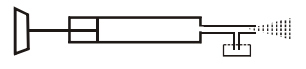
$1.$ If the piston is pushed at a speed of $5 \ mms ^{-1}$, the air comes out of the nozzle with a speed of
$(A)$ $0.1 \ ms ^{-1}$ $(B)$ $1 \ ms ^{-1}$ $(C)$ $2 \ ms ^{-1}$ $(D)$ $8 \ ms ^{-1}$
$2.$ If the density of air is $\rho_{ a }$ and that of the liquid $\rho_{\ell}$, then for a given piston speed the rate (volume per unit time) at which the liquid is sprayed will be proportional to
$(A)$ $\sqrt{\frac{\rho_{ a }}{\rho_{\ell}}}$ $(B)$ $\sqrt{\rho_a \rho_{\ell}}$ $(C)$ $\sqrt{\frac{\rho_{\ell}}{\rho_{ a }}}$ $(D)$ $\rho_{\ell}$
Give the answer question $1$ and $2.$