Question
If $\begin{bmatrix}\cos\frac{2\pi}{7}&-\sin\frac{2\pi}{7}\\\sin\frac{2\pi}{7}&\cos\frac{2\pi}{7}\end{bmatrix}^\text{k}=\begin{bmatrix}1&0\\0&1\end{bmatrix},$ then the least positive integral value of k is:
  1. 3
  2. 4
  3. 6
  4. 7

Answer

  1. 7
Solution:
$\text{A}=\begin{bmatrix}\cos\frac{2\pi}{7}&-\sin\frac{2\pi}{7}\\\sin\frac{2\pi}{7}&\cos\frac{2\pi}{7}\end{bmatrix}$
$\Rightarrow\text{A}^2=\text{A}\times\text{A}$
$\Rightarrow\text{A}^2=\begin{bmatrix}\cos\frac{2\pi}{7}&-\sin\frac{2\pi}{7}\\\sin\frac{2\pi}{7}&\cos\frac{2\pi}{7}\end{bmatrix}\begin{bmatrix}\cos\frac{2\pi}{7}&-\sin\frac{2\pi}{7}\\\sin\frac{2\pi}{7}&\cos\frac{2\pi}{7}\end{bmatrix}$
$\Rightarrow\text{A}^2=\begin{bmatrix}\cos^2\frac{2\pi}{7}-\sin^2\frac{2\pi}{7}&\Big(-2\cos\frac{2\pi}{7}-\sin\frac{2\pi}{7}\Big)\\2\cos\frac{2\pi}{7}\sin\frac{2\pi}{7}&\cos\frac{2\pi}{7}-\sin^2\frac{2\pi}{7}\end{bmatrix}$
$\Rightarrow\text{A}^2=\begin{bmatrix}\cos\frac{4\pi}{7}&-\sin\frac{4\pi}{7}\\\sin\frac{4\pi}{7}&\cos\frac{4\pi}{7}\end{bmatrix}$$\begin{bmatrix}\because\ \cos^2\theta-\sin^2\theta=\cos2\theta\\2\sin\theta\cos\theta=\sin2\theta\end{bmatrix}$
$\Rightarrow\text{A}^3=\text{A}^2\times\text{A}$
$\Rightarrow\text{A}^3=\begin{bmatrix}\cos\frac{4\pi}{7}&-\sin\frac{4\pi}{7}\\\sin\frac{4\pi}{7}&\cos\frac{4\pi}{7}\end{bmatrix}\begin{bmatrix}\cos\frac{2\pi}{7}&-\sin\frac{2\pi}{7}\\\sin\frac{2\pi}{7}&\cos\frac{2\pi}{7}\end{bmatrix}$
$\Rightarrow\text{A}^3=\begin{bmatrix}\Big(\cos\frac{4\pi}{7}\cos\frac{2\pi}{7}-\sin\frac{4\pi}{7}\sin\frac{2\pi}{7}\Big)&\Big(-\cos\frac{4\pi}{7}\sin\frac{2\pi}{7}-\sin\frac{4\pi}{7}\cos\frac{2\pi}{7}\Big)\\\Big(\sin\frac{4\pi}{7}\cos\frac{2\pi}{7}+\cos\frac{4\pi}{7}\sin\frac{2\pi}{7}\Big)&\Big(-\sin\frac{2\pi}{7}\sin\frac{4\pi}{7}+\cos\frac{4\pi}{7}\cos\frac{2\pi}{7}\Big)\end{bmatrix}$
$\Rightarrow\text{A}^3=\begin{bmatrix}\cos\frac{6\pi}{7}&-\sin\frac{6\pi}{7}\\\sin\frac{6\pi}{7}&\cos\frac{6\pi}{7}\end{bmatrix}$$\begin{bmatrix}\because\ \cos\text{(A+B)}=\cos\text{A}\cos\text{B}-\sin\text{A}\sin\text{B}\\\sin\text{(A+B)}=\sin\text{A}\cos\text{B}+\cos\text{A}\sin\text{B}\end{bmatrix}$
Now we check if the pattern is same for k = 6.
Here,
$\text{A}^6=\text{A}^3.\text{A}^3$
$\Rightarrow\text{A}^6=\begin{bmatrix}\cos\frac{6\pi}{7}&-\sin\frac{6\pi}{7}\\\sin\frac{6\pi}{7}&\cos\frac{6\pi}{7}\end{bmatrix}\begin{bmatrix}\cos\frac{6\pi}{7}&-\sin\frac{6\pi}{7}\\\sin\frac{6\pi}{7}&\cos\frac{6\pi}{7}\end{bmatrix}$
$\Rightarrow\text{A}^6=\begin{bmatrix}\cos\frac{12\pi}{7}&-\sin\frac{12\pi}{7}\\\sin\frac{12\pi}{7}&\cos\frac{12\pi}{7}\end{bmatrix}$
Now, we check if the pattern is same for k = 7.
Here,
$\text{A}^7=\text{A}^6\times\text{A}$
$\Rightarrow\text{A}^7=\begin{bmatrix}\cos\frac{6\pi}{7}&-\sin\frac{6\pi}{7}\\\sin\frac{6\pi}{7}&\cos\frac{6\pi}{7}\end{bmatrix}\begin{bmatrix}\cos\frac{2\pi}{7}&-\sin\frac{2\pi}{7}\\\sin\frac{2\pi}{7}&\cos\frac{2\pi}{7}\end{bmatrix}$
$\Rightarrow\text{A}^7=\begin{bmatrix}\cos\frac{14\pi}{7}&-\sin\frac{14\pi}{7}\\\sin\frac{14\pi}{7}&\cos\frac{14\pi}{7}\end{bmatrix}$
$\Rightarrow\text{A}^7=\begin{bmatrix}\cos2\pi&-\sin2\pi\\\sin2\pi&\cos2\pi\end{bmatrix}$$\begin{bmatrix}\because\ \frac{14\pi}{7}=2\pi\end{bmatrix}$
$=\begin{bmatrix}1&0\\0&1\end{bmatrix}$
So, the least positive integral value of k is 7.

Need a full question paper?

Generate a complete, print-ready paper with questions like this in minutes — across 16+ boards, with answer keys.
Start Generating Free

Similar questions

Let $A$ be a $3 \times 3$ matrix such that $|\operatorname{adj} A|=64$. Then $|A|$ is equal to:
Linear programming model which involves funds allocation of limited investment is classified as:
  1. Ordination budgeting model
  2. Capital budgeting models
  3. Funds investment models
  4. Funds origin models
If $\vec{\text{a}},\ \vec{\text{b}}$ are the vectors forming consecutive sides of a regular hexagon ABCDEF, then the vector representing side CD is,
  1. $\vec{\text{a}}+\vec{\text{b}}$
  2. $\vec{\text{a}}-\vec{\text{b}}$
  3. $\vec{\text{b}}-\vec{\text{a}}$
  4. $-\big(\vec{\text{a}}+\vec{\text{b}}\big)$
The general solution of the differential equation $\text{e}^\text{x}\ \text{dy}+(\text{y e}^\text{x}+2\text{x})\text{dx}=0\ \text{is}$
  1. $\text{x e}^\text{y}+\text{x}^2=\text{C}$
  2. $\text{x e}^\text{y}+\text{y}^2=\text{C}$
  3. $\text{y e}^\text{x}+\text{x}^{2}=\text{C}$
  4. $\text{y e}^\text{y}+\text{x}^2=\text{C}$
If the line joining $(2,3,-1)$ and $(3,5,-3)$ is perpendicular to the line joining $(1,2,3)$ and $(3,5, \lambda)$, then $\lambda=$
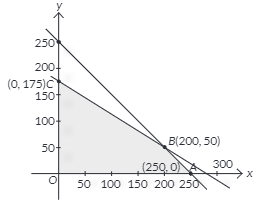
The corner points of the bounded feasible region of an LPP are $O(0,0), A(250,0), B(200,50)$ and $C(0,175)$. If the maximum value of the objective function $Z=2 a x+$ by occurs at the points $A(250,0)$ and $B(200,50)$, then the relation between $a$ and $b$ is:
Image
Let A and B be independent events with P(A) = 0.3 and P(B) = 0.4 Find P( A |B)
For what value of x, the matrix $A=\left[\begin{array}{rrr}0 & 1 & -2 \\ -1 & 0 & 3 \\ x & -3 & 0\end{array}\right]$ is skew-symmetric matrix?
If $\text{x}=\sin ^{ -1 }{ \text{K} },\text{y}=\cos ^{ -1 }\text{K}, -1\le \text{K}\le 1$, then the correct relationship is:
  1. $\text{x}+\text{y}=\frac{\pi}{8}$
  2. $\text{x}+\text{y}={2}$
  3. $\text{x}+\text{y}=\frac{\pi}{2}$
  4. $\text{x}+\text{y}=\frac{\pi}{8}$
If $\displaystyle \begin{vmatrix}\text{x} &\text{amp; } 1 \\ \text{y} &\text{amp; } 2 \end{vmatrix}-\displaystyle \begin{vmatrix}\text{y} &\text{amp; } 1 \\ 8&\text{amp; } 0\end{vmatrix}=\displaystyle \begin{vmatrix}2 &\text{amp; } 0 \\ \text{-x}&\text{amp; } 2\end{vmatrix}$ then the values of x and y respectively are:
  1. 5 and 1 
  2. 5 and 3
  3. 5 and 2
  4. 3 and 4