Question
If $\Big(\frac{\text{x}}{\text{a}}\sin\theta-\frac{\text{y}}{\text{b}}\cos\theta\Big)=1$ and $\Big(\frac{\text{x}}{\text{a}}\cos\theta+\frac{\text{y}}{\text{b}}\sin\theta\Big)=1,$ prove that $\Big(\frac{\text{x}^2}{\text{a}^2}+\frac{\text{y}^2}{\text{b}^2}\Big)=2.$
Answer

We have $\Big(\frac{\text{x}}{\text{a}}\sin\theta-\frac{\text{y}}{\text{b}}\cos\theta\Big)=1$
Squaring both side, we have:
$\Big(\frac{\text{x}}{\text{a}}\sin\theta-\frac{\text{y}}{\text{b}}\cos\theta\Big)^2=(1)^2$
$\Rightarrow\Big(\frac{\text{x}^2}{\text{a}^2}\sin^2\theta+\frac{\text{y}^2}{\text{b}^2}\cos^2\theta-2\frac{\text{x}}{\text{a}}\times\frac{\text{y}}{\text{b}}\sin\theta\cos\theta\Big)=1\dots(\text{i})$
Again, $\Big(\frac{\text{x}}{\text{a}}\cos\theta+\frac{\text{y}}{\text{b}}\sin\theta\Big)=1$
Squaring both side, we get:
$\Big(\frac{\text{x}}{\text{a}}\cos\theta+\frac{\text{y}}{\text{b}}\sin\theta\Big)^2=(1)^2$
$\Rightarrow\Big(\frac{\text{x}^2}{\text{a}^2}\cos^2\theta+\frac{\text{y}^2}{\text{b}^2}\sin^2\theta+2\frac{\text{x}}{\text{a}}\times\frac{\text{y}}{\text{b}}\sin\theta\cos\theta\Big)=1\dots(\text{ii})$
Now, adding (i) and (ii), we get:
$\Big(\frac{\text{x}^2}{\text{a}^2}\sin^2\theta+\frac{\text{y}^2}{\text{b}^2}\cos^2\theta-2\frac{\text{x}}{\text{a}}\times\frac{\text{y}}{\text{b}}\sin\theta\cos\theta\Big)\\ \ +\Big(\frac{\text{x}^2}{\text{a}^2}\cos^2\theta+\frac{\text{y}^2}{\text{b}^2}\sin^2\theta+2\frac{\text{x}}{\text{a}}\times\frac{\text{y}}{\text{b}}\sin\theta\cos\theta\Big)=2$
$\Rightarrow\frac{\text{x}^2}{\text{a}^2}\sin^2\theta+\frac{\text{y}^2}{\text{b}^2}\cos^2\theta-\frac{\text{x}^2}{\text{a}^2}\cos^2\theta+\frac{\text{y}^2}{\text{b}^2}\sin^2\theta=2$
$\Rightarrow\Big(\frac{\text{x}^2}{\text{a}^2}\sin^2\theta+\frac{\text{y}^2}{\text{a}^2}\cos^2\theta\Big)+\Big(\frac{\text{y}^2}{\text{b}^2}\cos^2\theta+\frac{\text{y}^2}{\text{b}^2}\sin^2\theta\Big)=2$
$\Rightarrow\frac{\text{x}^2}{\text{a}^2}\big(\sin^2\theta+\cos^2\theta\big)+\frac{\text{y}^2}{\text{b}^2}\big(\cos^2+\sin^2\theta\big)=2$
$\Rightarrow\frac{\text{x}^2}{\text{a}^2}+\frac{\text{y}^2}{\text{b}^2}=2$ $\big[\because\ \sin^2\theta+\cos^2\theta=1\big]$
$\therefore\ \frac{\text{x}^2}{\text{a}^2}+\frac{\text{y}^2}{\text{b}^2}=2$

Need a full question paper?

Generate a complete, print-ready paper with questions like this in minutes — across 16+ boards, with answer keys.

Start Generating Free

Similar questions

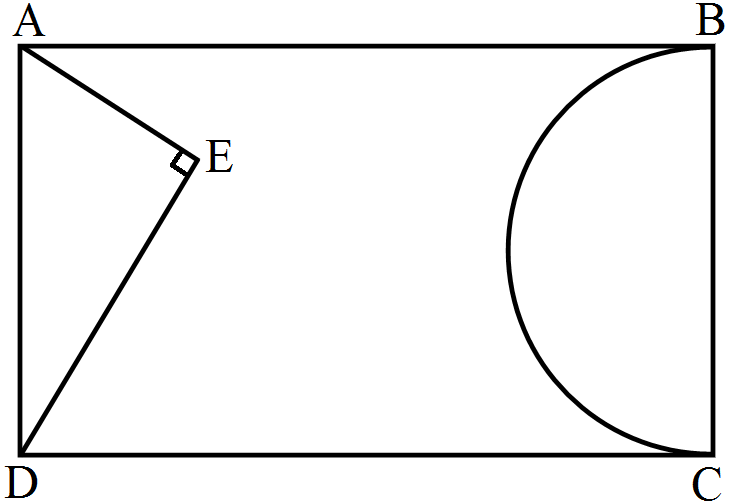
In the given figure, ABCD is a rectangle with $\text{AB}=80\text{cm}$ and $\text{BC}=70\text{cm},$ $\angle\text{AED}=90^\circ$ and $\text{DE}=42\text{cm}$ A semicircle is dn wn, taking BC as diameter. Find the area o the shaded region.
Two taps running together can fill a tank in $3\frac{1}{13}\ \text{hours.}$ If one pipe takes 3 hours more than the other to fill the tank then how much time will each tap take to fill the tank
The following table gives the daily income of 50 workers of a factory:
Daily income (in Rs) 100-120 120-140 140-160 160-180 180-200
Number of workers 12 14 8 6 10
Find the mean, mode and median of the above data.
A metallic cylinder has radius 3cm and height 5cm. To reuce its weight, a conical hole is drilled in the cylinder. The conical hole has a radius of $\frac{3}{2}\text{cm}$ and its depth is $\frac{8}{9}\text{cm}.$ Calculate the ratio of the volume of metal left in the cylinder to the volume of metal taken out in conical shape.
Find the area of the minor segment of a circle of radius 14cm, when the angle of the corresponding sector is 60°.
Solve the following system of equations by the method of cross-multiplication:
5ax + 6by = 28,
3ax + 4by = 18.
Prove the following trigonometric identities.
If $\sin\theta+2\cos\theta=1$ prove that $2\sin\theta-\cos\theta=2.$
Solve the following system of equations by the method of cross-multiplication:
$ax + by = a^2,$
$bx + ay = b^2.$
Solve the following quadratic equations by factorization:
$\frac{\text{a}}{\text{x}-\text{a}}+\frac{\text{b}}{\text{x}-\text{b}}=\frac{2\text{c}}{\text{x}-\text{c}}$
Draw a line segment AB of length 7cm. Using ruler and compasses, find a point P on AB such that $\frac{\text{AP}}{\text{AB}}=\frac{3}{5}.$