If charge on each plate of a parallel plate capacitor is $Q$ and the magnitude of electric field between the plates is $E$ then force on each plate of a parallel plate capacitor will be
Diffcult
Download our app for free and get started
Let $F$ be the force applied to separate the plates of a parallel plate capacitor by a distance of $\triangle x .$ Hence, work done by the force to do so $=F \triangle x$
As a result, the potential energy of the capacitor increases by an amount given as $u A \triangle x$
Where,
$u=$ Energy density
$A=$ Area of each plate
$d=$ Distance between the plates
$V=$ Potential difference across the plates
The work done will be equal to the increase in the potential energy i.e...
$F \triangle x=u A \triangle x$
$F=u A=\left(\frac{1}{2} \in_{0} E^{2}\right) A$
Electric intensity is given by, $E=\frac{V}{d}$
$\therefore F=\frac{1}{2} \in_{0}\left(\frac{V}{d}\right) E A=\frac{1}{2}\left(\in_{0} A \frac{V}{d}\right) E$
However, capacitance, $C=\frac{\epsilon_{0} A}{d}$
$\therefore F=\frac{1}{2}(C V) E$
Charge on the capacitor is given by, $Q=C V$
$\therefore F=\frac{1}{2} Q E$
The physical origin of the factor, $\frac{1}{2},$ in the force formula lies in the fact that just outside the conductor, field is $\mathrm{E}$ and inside it is zero. Hence, it is the average value,
$\frac{E}{2},$ of the field that contributes to the force.

Download our appand get started for free
Experience the future of education. Simply download our apps or reach out to us for more information. Let's shape the future of learning together!No signup needed.*
Similar Questions
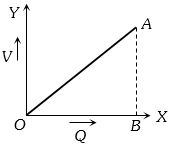
- 1Change $Q$ on a capacitor varies with voltage $V$ as shown in the figure, where $Q$ is taken along the $X$-axis and $V$ along the $Y$-axis. The area of triangle $OAB$ representsView Solution
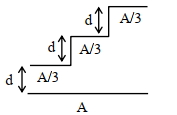
- 2A capacitor is made of a tlat plate of area $A$ and a second plate having a stair-like structure as shown in figure. If the area of each stair is $\frac{A}{3}$ and the height is $\mathrm{d}$, the capacitance of the arrangement is:View Solution
- 3The variation of electrostatic potential with radial distance $r$ from the centre of a positively charged metallic thin shell of radius $R$ is given by the graphView Solution
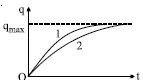
- 4The charge across the capacitor in two different $RC$ circuits $1$ and $2$ are plotted as shown in figure. Choose the correct statement $(s)$ related to the two circuits.View Solution
- 5The capacitance $(C)$ for an isolated conducting sphere of radius $(a)$ is given by $4\pi \varepsilon_0a$. If the sphere is enclosed with an earthed concentric sphere. The ratio of the radii of the spheres $\frac{n}{{(n - 1)}}$ being then the capacitance of such a sphere will be increased by a factorView Solution
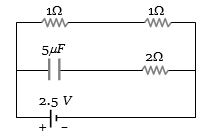
- 6A capacitor of capacitance $5\,\mu F$ is connected as shown in the figure. The internal resistance of the cell is $0.5\,\Omega $. The amount of charge on the capacitor plate is......$\mu C$View Solution
- 7At a certain distance from a point charge, the field intensity is $500\, Vm^{-1}$ and the potential is $-3000\, V$. The distance to the charge and the magnitude of the charge respectively areView Solution
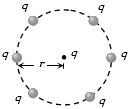
- 8A point charge is surrounded symmetrically by six identical charges at distance $r$ as shown in the figure. How much work is done by the forces of electrostatic repulsion when the point charge $q$ at the centre is removed at infinityView Solution
- 9View SolutionVariation in electric potential is maximum if one goes
- 10View SolutionAssertion : The electrostatic force between the plates of a charged isolated capacitor decreases when dielectric fills whole space between plates.
Reason : The electric field between the plates of a charged isolated capacitance increases when dielectric fills whole space between plates.