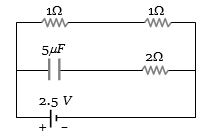
A capacitor of capacitance $5\,\mu F$ is connected as shown in the figure. The internal resistance of the cell is $0.5\,\Omega $. The amount of charge on the capacitor plate is......$\mu C$
Medium
Download our app for free and get started
(c) In steady state condition. No current flows through line $(1)$. Hence total current $i = \frac{{2.5}}{{(1 + 1 + 0.5)}} = 1\,A$
Potential difference a cross line $(2)$ $=$ potential difference a cross capacitor
$ = 1 \times 2 = 2\,Volt$
So, charge on capacitor = $5 × 2$ = $10 \,µC$
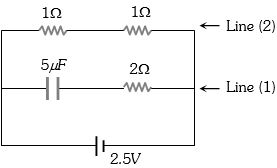
Potential difference a cross line $(2)$ $=$ potential difference a cross capacitor
$ = 1 \times 2 = 2\,Volt$
So, charge on capacitor = $5 × 2$ = $10 \,µC$

Download our appand get started for free
Experience the future of education. Simply download our apps or reach out to us for more information. Let's shape the future of learning together!No signup needed.*
Similar Questions
- 1View SolutionA capacitor is charged by a battery. The battery is removed and another identical uncharged capacitor is connected in parallel. The total electrostatic energy of resulting system
- 2A block of mass $m$ moving with speed $v$ compresses a spring through distance $x$ before its speed is halved. What is the value of spring constant ?View Solution
- 3View SolutionA spherical portion has been removed from a solid sphere having a charge distributed uniformly in its volume in the figure. The electric field inside the emptied space is

- 4A parallel plate capacitor with plate separation $5$ $\mathrm{mm}$ is charged up by a battery. It is found that on introducing a dielectric sheet of thickness $2 \mathrm{~mm}$, while keeping the battery connections intact, the capacitor draws $25 \%$ more charge from the battery than before. The dielectric constant of the sheet is_____.View Solution
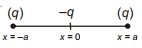
- 5Three charges are placed along $x$-axis at $x=-a, x=0$ and $x=a$ as shown in the figure. The potential energy of the system isView Solution
- 6The two thin coaxial rings, each of radius $'a'$ and having charges $+{Q}$ and $-{Q}$ respectively are separated by a distance of $'s'.$ The potential difference between the centres of the two rings is :View Solution
- 7The energy of a charged capacitor is given by the expression ($q$= charge on the conductor and $C$ = its capacity)View Solution
- 8There are two identical capacitors, the first one is uncharged and filled with a dielectric of constant $K$ while the other one is charged to potential $V$ having air between its plates. If two capacitors are joined end to end, the common potential will beView Solution
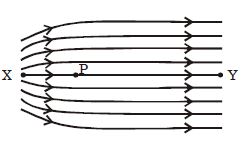
- 9The diagram below shows electric field lines in a region of space. Which of the following diagrams best shows the variation with distance $d$ of the potential $V$ along the line $XY$ as we move from $X$ to $Y$ ?View Solution
- 10Two capacitances of capacity ${C_1}$ and ${C_2}$ are connected in series and potential difference $V$ is applied across it. Then the potential difference across ${C_1}$ will beView Solution