MCQ
If doubling the concentration of a reactant $ 'A'$  increases the rate $4$ times and tripling the concentration of $'A' $ increases the rate $9$  times, the rate is proportional to
  • A
    Concentration of  $`A'$
  • Square of concentration of $ `A'$
  • C
    Under root of the concentration of $ `A'$
  • D
    Cube of concentration of $ `A'$

Answer

Correct option: B.
Square of concentration of $ `A'$
b
(b)${2^2} = 4,\,\,{3^2} = 9$

Need a full question paper?

Generate a complete, print-ready paper with questions like this in minutes — across 16+ boards, with answer keys.

Start Generating Free

Similar questions

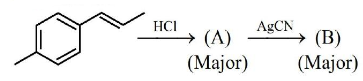
The product B formed in the following reaction sequence is :
Image
In equimolar solution of glucose, $NaCl$ and $BaC{l_2}$, the order of osmotic pressure is as follow
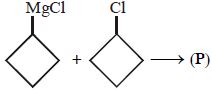
Compound $(P)$ is
The enthalpy change on freezing of $1\, mol$ of water at $5\,^oC$ to ice at $-5\,^oC$ is .....$ kJ\, mol^{-1}$

(Given ${\Delta _{fus}}H = 6\, kJ\, mol^{-1}$ at $0\,^oC$,

$C_p(H_2O, l) =75.3\, J\, mol^{-1} \, K^{-1}$ ,

$C_p(H_2O, s) = 36.8\, J\, mol^{-1} \, K^{ -1}$ )

$A + 2B \to C + D$. If $ - \frac{{d[A]}}{{dt}} = 5 \times {10^{ - 4}}\,mol\,{l^{ - 1}}{s^{ - 1}}$1, then $ - \frac{{d[B]}}{{dt}}$ is
For the reaction $A \to B$, the rate increases by a factor of $2.25 $ when the concentration of $A$ is increased by $ 1.5$. What is the order of the reaction
Which of the following order is correct for the property mentioned in brackets ?
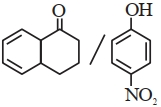
Match items of column $I$ and $II$

Column $I$ (Mixture of compounds) Column $II$ (Separation Technique)
$A$ $H _2 O / CH _2 Cl _2$ $I$ Crystallization
$B$ $Image$ $II$ Differential solvent extraction
$C$ Kerosene/Naphthalene $III$ Column chromatography
$D$ $C _6 H _{12} O _6 / NaCl$ $IV$ Fractional Distillation

Correct match is : 

Given are $E^o$ values for some half reactions

$I_2 + 2e^-\to 2I^-$  ;     $E^o = 0.54 \,V$

$MnO_4^-+ 8H^+ + 5e^-\to  Mn^{2+} + 4H_2O$  ;  $E^o = 1.52\, V$

$Fe^{3+} + e^-\to Fe^{2+}$ ;     $E^o = 0.77\, V$

$Sn^{4+} + 2e^-\to Sn^{2+}$ ;    $E^o = 0.1\, V$
The strongest reducant and oxidant respectively are :

What metals combine with non-metals, the metal atom tends to