MCQ
If earth suddenly stops rotating about its own axis, the increase in it’s temperature will be
  • $\frac{{{R^2}{\omega ^2}}}{{5Js}}$
  • B
    $\frac{{{R^2}{\omega ^2}}}{{Js}}$
  • C
    $\frac{{Rm{\omega ^2}}}{{5Js}}$
  • D
    None of these

Answer

Correct option: A.
$\frac{{{R^2}{\omega ^2}}}{{5Js}}$
a
(a) $W = JQ \Rightarrow \frac{1}{2}I{\omega ^2} = J(MS\Delta \theta ) \Rightarrow \frac{1}{2}\left( {\frac{2}{5}M{R^2}} \right)\,{\omega ^2}$

$ = J(MS\Delta \theta ) \Rightarrow \Delta \theta = \frac{{{R^2}{\omega ^2}}}{{5Js}}$

Need a full question paper?

Generate a complete, print-ready paper with questions like this in minutes — across 16+ boards, with answer keys.
Start Generating Free

Similar questions

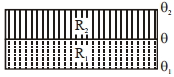
The temperature $\theta$ at the junction of two insulating sheets, having thermal resistances $R _{1}$ and $R _{2}$ as well as top and bottom temperatures $\theta_{1}$ and $\theta_{2}$ (as shown in figure) is given by
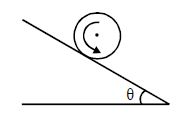
A disc is given angular velocity ${\omega _0}$ as shown in figure and kept on an inclined plane of inclination $\theta $ having coefficient of friction $\mu$ = $tan \theta $ . The initial acceleration of centre of mass is $a$ and angular acceleration $\alpha $ , then
Two magnets, each of magnetic moment $‘M’ $ are placed so as to form a cross at right angles to each other. The magnetic moment of the system will be
The ratio of two specific heats of gas ${C_p}/{C_v}$ for argon is $1.6$ and for hydrogen is $1.4$. Adiabatic elasticity of argon at pressure $P$ is $E.$ Adiabatic elasticity of hydrogen will also be equal to $E$ at the pressure
A deviation of $2^{\circ}$ is produced in the yellow ray when prism of crown and flint glass are achromatically combined. Taking dispersive powers of crown and flint glass are $0.02$ and $0.03$ respectively and refractive index for yellow light for these glasses are $1.5$ and $1.6$ respectively. The refracting angles for crown glass prism will be $........\,^{\circ}$ (in degree) (Round off to the Nearest Integer)
If ${R}_{{E}}$ be the radius of Earth, then the ratio between the acceleration due to gravity at a depth $' {r} '$ below and a height $' r '$ above the earth surface is:

(Given : $\left.{r}<{R}_{{E}}\right)$
A lamp emits monochromatic green light uniformly in all directions. The lamp is $3\%$ efficient in converting electrical power to electromagnetic waves and consumes $100\,W$ of power . The amplitude of the electric field associated with the electromagnetic radiation at a distance of $5\,m$ from the lamp will be nearly.......$V/m$
$A$ paritcle falls freely near the surface of the earth. Consider $a$ fixed point $O$ (not vertically below the particle) on the ground.
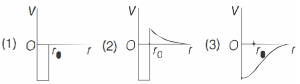
Given below are three schematic graphs of potential energy $V(r)$ versus distance $r$ for three atomic particles : electron $\left(e^{-}\right)$, proton $\left(p^{+}\right)$and neutron $(n)$, in the presence of a nucleus at the origin $O$. The radius of the nucleus is $r_0$. The scale on the $V$-axis may not be the same for all figures. The correct pairing of each graph with the corresponding atomic particle is
Light with an average flux of $20\, W / cm ^{2}$ falls on a non-reflecting surface at normal incidence having surface area $20\, cm ^{2} .$ The energy recelved by the surface during time span of $1$ minute is $............J$