MCQ
If $f : A \rightarrow B$ given by $3^{f(x)} + 2^{-x} = 4$ is a bijection, then
  • A
    $\text{A}=\{\text{x}\in\text{R}:-1<\text{x}<\infty\},$ $\text{B}=\{\text{x}\in\text{R}:2<\text{x}<4\}$
  • B
    $\text{A}=\{\text{x}\in\text{R}:-3<\text{x}<\infty\},$ $\text{B}=\{\text{x}\in\text{R}:2<\text{x}<4\}$
  • C
    $\text{A}=\{\text{x}\in\text{R}:-2<\text{x}<\infty\},$ $\text{B}=\{\text{x}\in\text{R}:2<\text{x}<4\}$
  • None of these.

Answer

Correct option: D.
None of these.
$\text{f}:\text{A}\Rightarrow \text{B}$
$3^\text{f(x)}+2^{-\text{x}}=4$
$\Rightarrow 3^{\text{f(x)}}=4-2^{-\text{x}}$
Taking $\log$ on both the sides,
$\text{f(x)}\log3=\log(4-2^{-\text{x}})$
$\Rightarrow \text{f(x)}=\frac{\log(4-2^{-\text{x}})}{\log3}$
Logaritmic function will only be defined if $4-2^{-\text{x}}>0$
$\Rightarrow 4>2^{-\text{x}}$
$\Rightarrow 2^2>2^{-\text{x}}$
$\Rightarrow 2>-\text{x}$
$\Rightarrow-2<\text{x}$
$\Rightarrow \text{x}\in(-2,\infty)$
That means $\text{A}=\{\text{x}\in\text{R}:-2<\text{x}<\infty\}$
As we know that, $\text{f(x)}=\frac{\log(4-2^{-\text{x}})}{\log3}$
We take $\text{x}=0\in(-2,\infty)$
$\Rightarrow f(x) = 1$ which does not belong to any of the options.

Need a full question paper?

Generate a complete, print-ready paper with questions like this in minutes — across 16+ boards, with answer keys.

Start Generating Free

Similar questions

If $f(x) = {\log _a}x$ and $F(x) = {a^x}$, then $F[f(x)]$ is
Find the value of $\int \sin ^2 x d x$ :
$\text { If } \int_{0}^{100 \pi} \frac{\sin ^{2} x}{e^{\left(\frac{x}{\pi}-\left[\frac{x}{\pi}\right]\right)}} d x=\frac{\alpha \pi^{3}}{1+4 \pi^{2}}, \alpha \in R$

where $[x]$ is the greatest integer less than or equal to $x$, then the value of $\alpha$ is :

If $f(x) = \left| {\begin{array}{*{20}{c}}1&x&{x + 1}\\{2x}&{x(x - 1)}&{(x + 1)x}\\{3x(x - 1)}&{x(x - 1)(x - 2)}&{(x + 1)x(x - 1)}\end{array}} \right|$ then $f(100)$ is equal to
$\smallint \frac{{2{x^{12}} + 5{x^9}}}{{{{\left( {{x^5} + {x^3} + 1} \right)}^3}}}dx = $
Let three matrices $A =$$\left[ {\begin{array}{*{20}{c}}2&1\\4&1\end{array}} \right]$ ; $B =$$\left[ {\begin{array}{*{20}{c}}3&4\\2&3\end{array}} \right]$ and $C =$$\left[ {\begin{array}{*{20}{c}}3&{ - 4}\\{ - 2}&3\end{array}} \right]$ then $T_r(A) + t_r$ $\left( {\frac{{ABC}}{2}} \right)$ $+$ $t_r$$\left( {\frac{{A{{(BC)}^2}}}{4}} \right)$  $+$ $t_r$ $\left( {\frac{{A{{(BC)}^3}}}{8}} \right)$ $+$ ....... $+ \infty =$
Choose the correct answer from the given four options.

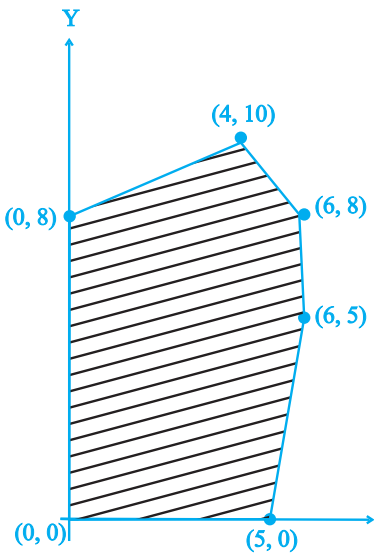
The feasible solution for a LPP shown in Fig. 12.12. Let z = 3x - 4y be objective functio. (Maximum value of Z + Minimum value of Z) is equal to:
If $A$ and $B$ are the points $(-3,4,-8)$ and $(5,-6,4)$ respectively, then find the ratio in which $y z$-plane divides $\overrightarrow{A B}$.
Out of the following a skew- symmetric matrix is
The figure formed by the four points $i + j - k,\,\,\,2i + 3j,$ $3i + 5j - 2k$ and $k - j$ is