MCQ
If $f\left( x \right) = \left| {\begin{array}{*{20}{c}}
  {\sin \left( {x + \alpha } \right)}&{\sin \left( {x + \beta } \right)}&{\sin \left( {x + \gamma } \right)} \\ 
  {\cos \left( {x + \alpha } \right)}&{\cos \left( {x + \beta } \right)}&{\cos \left( {x + \gamma } \right)} \\ 
  {\sin \left( {\alpha  + \beta } \right)}&{\sin \left( {\beta  + \gamma } \right)}&{\sin \left( {\gamma  + \alpha } \right)} 
\end{array}} \right|$ and $f(10) = 10$ then $f(\pi)$ is equal to
  • A
    $0$
  • B
    $\pi$
  • $10$
  • D
    None of these

Answer

Correct option: C.
$10$
c
$f'\left( x \right) = \left| {\begin{array}{*{20}{c}}
{\cos \left( {x + \alpha } \right)}&{\cos \left( {x + \beta } \right)}&{\cos \left( {x + \gamma } \right)}\\
{\sin \left( {\alpha  + \beta } \right)}&{\sin \left( {\beta  + \gamma } \right)}&{\sin \left( {\gamma  + \alpha } \right)}
\end{array}} \right|$

$ + \left( { - 1} \right)\left| {\begin{array}{*{20}{c}}
{\sin \left( {x + \alpha } \right)}&{\sin \left( {x + \beta } \right)}&{\sin \left( {x + \gamma } \right)}\\
{\sin \left( {\alpha  + \beta } \right)}&{\sin \left( {\beta  + \gamma } \right)}&{\sin \left( {\gamma  + \alpha } \right)}
\end{array}} \right|$

$ + \left| {\begin{array}{*{20}{c}}
{\sin \left( {x + \alpha } \right)}&{\sin \left( {x + \alpha } \right)}&{\sin \left( {x + \gamma } \right)}\\
{\cos \left( {x + \alpha } \right)}&{\cos \left( {x + \alpha } \right)}&{\cos \left( {x + \gamma } \right)}\\
0&0&0
\end{array}} \right|$

$ = 0 - 0 + 0 = 0$

Henc, $f(x)$ is a constant $f'n;$

$\because $ $f\left( {10} \right) = 10\,\,\,\,\,\,\, \Rightarrow \boxed{f\left( x \right)10}$

Need a full question paper?

Generate a complete, print-ready paper with questions like this in minutes — across 16+ boards, with answer keys.

Start Generating Free

Similar questions

If $y=y(x)$ is the solution of the differential equation $\frac{5+ e ^{ x }}{2+ y } \cdot \frac{ dy }{ dx }+ e ^{ x }=0$ satisfying $y (0)=1,$ then a value of $y \left(\log _{ e } 13\right)$ is 
The function ${{x - 2} \over {x + 1}},(x \ne - 1)$ is increasing on the interval
The value of the definite integral $\int_0^1 {\frac{{x\,dx}}{{{x^3} + 16}}} $ lies in the interval $[a,\,\,b].$ The smallest such interval is
$\int_{}^{} {\frac{{\sqrt x }}{{1 + x}}dx = } $
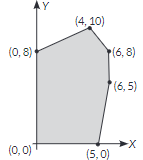
In the given graph, the feasible region for a LPP is shaded. The objective function $Z=2 x-3 y$, will be minimum at
Image
A tetrahedron of volume $5$  has three of its vertices at the points $A(2,1,-1), \,\,B(3,0,1)$ and $C(2,-1,3).$ If the fourth vertex $D$ lies on the $y-$ axis, then sum of ordinates of all possible points $D$ is-
$\int\Big(\frac{4\text{e}^\text{x}-25}{2\text{e}^{\text{x}}-5}\Big)\text{dx}=\text{Ax}+\text{B}\log\mid{2\text{e}^\text{x}-5}\mid+\text{ c}$ then:
  1. A = 5, B = 3
  2. A = 5, B = -3
  3. A = -5, B = 3
  4. A = -5, B = -3
If $\vec{a} = \hat{i} - \hat{j} - \hat{k}$ and $\vec{b} = \lambda\hat{i} - 3\hat{j} + \hat{k}$ and the orthogonal projection of $\vec{b}$ on $ \vec{a} $ is $\frac{4}{3}(\hat{i}- \hat{j} -\hat{k})$,then $\lambda$ is equal to :-
If one pair of two unbiased dice are rolled then what is the probability of getting sum 5 ?
Forces $3\overrightarrow{\text{OA}},\ 5\overrightarrow{\text{OB}}$ act along OA and OB. If their resultant passes through C on AB, then,
  1. C is a mid-point of AB.
  2. C divides AB in the ratio 2 : 1
  3. 3AC = 5CB
  4. 2AC = 3CB