MCQ
If for two vector $\vec{A}$ and $\vec{B}$, sum $(\vec{A} \quad \vec{B})$ is perpendicular to the difference $\left(\begin{array}{ll}A & \vec{B}\end{array}\right)$. The ratio of their magnitude is
  • 1
  • B
    2
  • C
    3
  • D
    None of these

Answer

Correct option: A.
1
(a) $(\vec{A}+\vec{B})$ is perpendicular to $(\vec{A}-\vec{B})$. Thus$\begin{aligned}& (\vec{A}+\vec{B}) \cdot(\vec{A}-\vec{B})=0 \\& \text { or } A^2+\vec{B} \cdot \vec{A}-\vec{A} \cdot \vec{B}-B^2=0\end{aligned}$Because of commutative property of dot product $\vec{A} \cdot \vec{B}=\vec{B} \cdot \vec{A}$$\therefore A^2-B^2=0 \text { or } A=B$Thus the ratio of magnitudes $A / B=1$

Need a full question paper?

Generate a complete, print-ready paper with questions like this in minutes — across 16+ boards, with answer keys.
Start Generating Free

Similar questions

A Carnot's engine used first an ideal monoatomic gas then an ideal diatomic gas. If the source and sink temperature are $411^{\circ} \mathrm{C}$ and $69^{\circ} \mathrm{C}$ respectively and the engine extracts $1000 \mathrm{~J}$ of heat in each cycle, then area enclosed by the PV diagram is
Two bulbs are in parallel and they together consume $48 W$ from a battery of $6 V$. The resistance of each bulb is
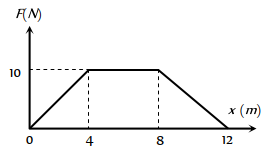
A particle of mass $0.1 \mathrm{~kg}$ is subjected to a force which varies with distance as shown in fig. If it starts its journey from rest at $x=0$, its velocity at $x=12 \mathrm{~m}$ is
Image
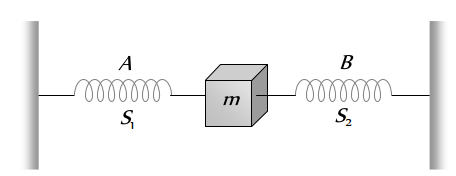
In the figure, $S_1$ and $S_2$ are identical springs. The oscillation frequency of the mass $m$ is $f$. If one spring is removed, the frequency will become

Image

Which of the following quantity is expressed as force per unit area
If force $(\vec{F})=4 \hat{i}+5 \hat{j}$ and displacement $(\vec{s})=3 \hat{i}+6 \hat{k}$ then the work done is
A galvanometer of resistance $25 \Omega$ gives full scale deflection for a current of 10 milliampere, is to be changed into a voltmeter of range $100 V$ by connecting a resistance of ' $R$ ' in series with galvanometer. The value of resistance $R$ in $\Omega$ is
The equation of motion of a particle is $\frac{d^2 y}{d t^2}+K y=0$, where $K$ is positive constant. The time period of the motion is given by
A transverse wave is described by the equation $Y=Y_0 \sin 2 \pi\left(f t-\frac{x}{\lambda}\right)$. The maximum particle velocity is four times the wave velocity if
The force required just to move a body up an inclined plane is double the force required just to prevent the body sliding down. If the coefficient of friction is $0.25,$ the angle of inclination of the plane is