MCQ
If $f(x)$ be such that $f(x) = max (|2-x|, 2-x^3), x \in R$
  • A
    $f(x)$ is discontinuous at one point
  • B
    $f(x)$ is differentiable $\forall  x \in R$
  • C
    $f(x)$ is non differentiable at one point only
  • $f(x)$ is non differentiable at $4$ points only
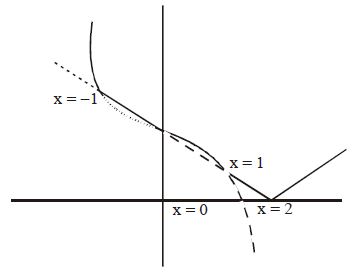
Answer

Correct option: D.
$f(x)$ is non differentiable at $4$ points only
d

Need a full question paper?

Generate a complete, print-ready paper with questions like this in minutes — across 16+ boards, with answer keys.

Start Generating Free

Similar questions

The value of $\int\limits^1_0\tan^{-1}\Big(\frac{2\text{x}-1}{1+\text{x}-\text{x}^2}\Big)\text{ dx},$ is:
  1. 1
  2. 0
  3. -1
  4. $\frac{\pi}{4}$
Let $( a , b ) \subset(0,2 \pi)$ be the largest interval for which $\sin ^{-1}(\sin \theta)-\cos ^{-1}(\sin \theta) > 0, \theta \in(0,2 \pi)$ holds. If $\alpha x^2+\beta x+\sin ^{-1}\left(x^2-6 x+10\right)+\cos ^{-1}$ $\left(x^2-6 x+10\right)=0$ and $\alpha-\beta=b-a$, then $\alpha$ is equal to:
The integrating factor of the differential equation $\frac{{dy}}{{dx}} = y\tan x - {y^2}\sec x,$is
The rate of change of $\sqrt {({x^2} + 16)} $ with respect to ${x \over {x - 1}}$ at $x = 3$ is
Let $f: R \rightarrow R$ be a differentiable function such that $f(a)=0=f(b)$ and $f^{\prime}(a) f^{\prime}(b) > 0$ for some $a < b$. Then, the minimum number of roots of $f^{\prime}(x)=0$ in the interval $(a, b)$ is
Let X1 and X2 are optimal solutions of a LPP, then:
  1. $\text{X}=\lambda\ \text{X}_1+(1-\lambda)\text{X}_2,\lambda\in$ R is also an optimal solution
  2. $\text{X}=\lambda\ \text{X}_1+(1-\lambda)\text{X}_2,0\leq\lambda\leq1$ given an optimal solution
  3. $\text{X}=\lambda\ \text{X}_1+(1+\lambda)\text{X}_2,0\leq\lambda\leq1$ given an optimal solution
  4. $\text{X}=\lambda\ \text{X}_1+(1+\lambda)\text{X}_2,\lambda\in$ R given an optimal solution
The differential equation $\text{x}\frac{\text{dy}}{\text{dx}}-\text{y}=\text{x}^{2}$ has the general solution:
  1. y - x3 = 2Cx
  2. 2y - x3 = Cx
  3. 2y + x2 = 2Cx
  4. y + x2 = 2Cx
Suppose $f ( x )$ is a polynomial of degree four, having critical points at $-1,0,1$ . If $T =\{ x \in R \mid f ( x )= f (0)\},$ then the sum of squares of all the elements of $T$ is
Let $l =\mathop {Lim}\limits_{x \to \infty } \,\,\int\limits_x^{2x} {\frac{{dt}}{t}} $ and $m = \frac{1}{{x\,\ln \,x}}\,\,\int\limits_1^x {\ln \,t\,dt} $ then the correct statement is
The maximum value of Z = 3x + 4y subjected to contraints $\text{x}+\text{y}\leq40,\text{x}+2\text{y}\leq60,\text{x}\geq0$ and $\text{y}\geq0$ is: