MCQ
If $f(x)$ be such that $f(x) = max (|2-x|, 2-x^3), x \in R$
  • A
    $f(x)$ is discontinuous at one point
  • B
    $f(x)$ is differentiable $\forall  x \in R$
  • C
    $f(x)$ is non differentiable at one point only
  • $f(x)$ is non differentiable at $4$ points only
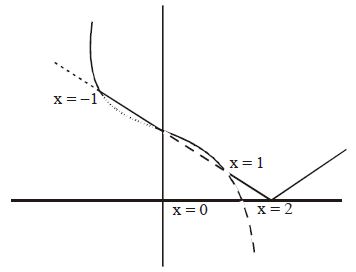
Answer

Correct option: D.
$f(x)$ is non differentiable at $4$ points only
d

Need a full question paper?

Generate a complete, print-ready paper with questions like this in minutes — across 16+ boards, with answer keys.

Start Generating Free

Similar questions

The direction cosines of the normal to the plane $x + 2y - 3z + 4 = 0$ are
The probability that a student is not a swimmer is $\frac{1}{5}$. Then the probability that out of five students, four are swimmers is
If a system of the equation ${(\alpha + 1)^3}x + {(\alpha + 2)^3}y - {(\alpha + 3)^3} = 0$ and $(\alpha + 1)x + (\alpha + 2)y - (\alpha + 3) = 0,x + y - 1 = 0$ is constant. what is the value of $\alpha $
If $A\,( - 1,\,\,2,\,\,3),\,\,B\,(1,\,\,1,\,\,1)$ and $C\,(2,\,\, - 1,\,\,3)$ are points on a plane. A unit normal vector to the plane  $ABC$ is
If $\vec{\text{a}}=2\hat{\text{i}}-3\hat{\text{j}}+5\hat{\text{k}},\vec{\text{b}}=3\hat{\text{i}}-4\hat{\text{j}}+5\hat{\text{k}}$ and $\vec{\text{c}}=5\hat{\text{i}}-3\hat{\text{j}}-2\hat{\text{k}},$ then the volume of the parallelopiped with contermious edges $\vec{\text{a}}+\vec{\text{b}},\vec{\text{b}}+\vec{\text{c}},\vec{\text{c}}+\vec{\text{a}}$ is:
If $\left| {\begin{array}{*{20}{c}}
  {^9{C_4}}&{^9{C_5}}&{^{10}{C_r}} \\ 
  {^{10}{C_6}}&{^{10}{C_7}}&{^{11}{C_{r + 2}}} \\ 
  {^{11}{C_8}}&{^{11}{C_9}}&{^{12}{C_{r + 4}}} 
\end{array}} \right| = 0$ then $r$ is equal to 
$\int {} $ $e^{\tan \theta} $ $(\sec \theta - \sin \theta )$ $ d\theta $ equals :
The matrix $\text{A}=\begin{bmatrix}0&\text{amp};0&\text{amp};0\\0&\text{amp};4&\text{amp};0\\4&\text{amp};0&\text{amp};0\end{bmatrix}$ is $a$ :
Consider the function $\mathrm{f}:(0,2) \rightarrow \mathrm{R}$ defined by $f(x)=\frac{x}{2}+\frac{2}{x}$ and the function$ g(x)$ defined by $g(x)=\left\{\begin{array}{cc}\min \{f(t)\}, & 0 < t \leq x \text { and } 0 < x \leq 1 \\ \frac{3}{2}+x, & 1 < x< 2\end{array}\right.$. Then
The solution of the equation $(1 + {x^2})\frac{{dy}}{{dx}} = 1$ is