MCQ
If $f(x) = {e^x}g(x),g(0) = 2,g'(0) = 1$, then $f'(0)$ is
  • A
    $1$
  • $3$
  • C
    $2$
  • D
    $0$

Answer

Correct option: B.
$3$
b
(b) $f(x) = {e^x}g(x) \Rightarrow f'(x) = {e^x}g(x) + {e^x}g'(x)$

$ \Rightarrow f'(0) = g(0) + g'(0) = 2 + 1 = 3$.

Need a full question paper?

Generate a complete, print-ready paper with questions like this in minutes — across 16+ boards, with answer keys.
Start Generating Free

Similar questions

The value of $\int\limits^\frac{\pi}{2}_{-\frac{\pi}{2}}\big(\text{x}^3+\text{x}\cos\text{x}+\tan^5\text{x}+1\big)\text{dx},$ is:
  1. 0
  2. 2
  3. $\pi$
  4. 1
If the function $\text{f}(\text{x})=\cos|\text{x}|-2\text{ax}+\text{b}$ increases along entire number scale, then:
  1. $\text{a}=\text{b}$
  2. $\text{a}=\frac{1}{2}\text{b}$
  3. $\text{a}\leq-\frac{1}{2}$
  4. $\text{a}>-\frac{3}{2}$
Let $f:R \to R$ and $g:R \to R$ be continuous functions, then the value of the integral
$\int_{ - \pi /2}^{\pi /2} {[f(x) + f( - x)]\,\,[g(x) - g( - x)]\,dx = } $
If $A = \left[ {\begin{array}{*{20}{c}}1&2&3\\{ - 2}&3&{ - 1}\\3&1&2\end{array}} \right]$and $I $is a unit matrix of ${3^{rd}}$order, then $({A^2} + 9I)$ equals
The vector equation of the plane passing through $\vec{\text{a}},\ \vec{\text{b}},\ \vec{\text{c}},$ is $\vec{\text{r}}=\alpha\vec{\text{a}}+\beta\vec{\text{b}}+\gamma\vec{\text{c}}$, provided that,
  1. $\alpha+\beta+\gamma=0$
  2. $\alpha+\beta+\gamma=1$
  3. $\alpha+\beta=\gamma$
  4. $\alpha^2+\beta^2+\gamma^2=1$
Let $f(x)=\int_{0}^{x} e^{t} f(t) d t+e^{x}$ be a differentiable function for all $x \in R$. Then $f(x)$ equals ..... .
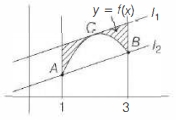
The following figure shows the graph of a continuous function $y=f(x)$ on the interval $[1,3]$. The points $A, B, C$ have coordinates $(1,1),(3,2),(2,3)$ respectively, and the lines $l_1$ and $l_2$ are parallel, with $l_1$ being tangent to the curve at $C$. If the area under the graph of $y=f(x)$ from $x=1$ to $x=3$ is $4$ sq units, then the area of the shaded region is
If $A = \left| {\,\begin{array}{*{20}{c}}5&6&3\\{ - 4}&3&2\\{ - 4}&{ - 7}&3\end{array}\,} \right|\,, $ then cofactors of the elements of $2^{nd}$ row are
$\int_{0}^{\pi /2}{\frac{dx}{{{a}^{2}}{{\cos }^{2}}x+{{b}^{2}}{{\sin }^{2}}x}}\,=$
Let * be a binary operation on N defined by a * b = a + b + 10 for all a, b ∈ N. The identity element for * in N is:
  1. −10
  2. 0
  3. 10
  4. Non-existent.