MCQ
If $f(x)\ =$ min. $\{1, x^2, x^3\},$ then
  • A
    $f(x)$ is discontinuous $\forall \,x\, \in \,R$
  • B
    $f(x) > 0$  $\forall \,x\, \in \,R$
  • $f(x)$ is not differentiable but continuous $\forall \,x\, \in \,R$
  • D
    $f(x)$ is not differentiable for two values of $x$
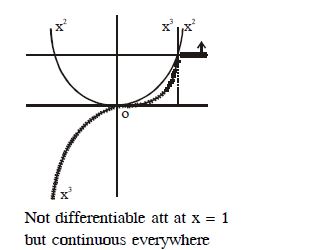
Answer

Correct option: C.
$f(x)$ is not differentiable but continuous $\forall \,x\, \in \,R$
c

Need a full question paper?

Generate a complete, print-ready paper with questions like this in minutes — across 16+ boards, with answer keys.

Start Generating Free

Similar questions

Find which of the binary operations are commutative and which are associative.
Consider a binary operation * on N defined as a * b = a3 + b3. Choose the
correct answer.
  1. Is * both associative and commutative?
  2. Is * commutative but not associative?
  3. Is * commutative but not associative?
  4. Is * neither commutative nor associative?
Which of the following triplets give the direction cosines of a line:
The value of the definite integral

$\int_{-\frac{\pi}{4}}^{\frac{\pi}{4}} \frac{d x}{\left(1+e^{x \cos x}\right)\left(\sin ^{4} x+\cos ^{4} x\right)}$

is equal to:

If $p{\lambda ^4} + q{\lambda ^3} + r{\lambda ^2} + s\lambda + t = $ $\left| {\,\begin{array}{*{20}{c}}{{\lambda ^2} + 3\lambda }&{\lambda - 1}&{\lambda + 3}\\{\lambda + 1}&{2 - \lambda }&{\lambda - 4}\\{\lambda - 3}&{\lambda + 4}&{3\lambda }\end{array}\,} \right|,$ the value of $t$ is
If R is a relation on the set A = {1, 2, 3} given by R = {(1, 1), (2, 2), (3, 3)}, then R is:
  1. Reflexive.
  2. Symmetric.
  3. Transitive.
  4. All the three options.
The function f : R → R defined by f(x) = (x - 1)(x - 2)(x - 3) is:
  1. One-one but not onto.
  2. Onto but not one-one.
  3. Both one and onto.
  4. Neither one-one nor onto.
Let $f$ be a function satisfying $f(xy) = \frac{f(x)}{y}$ for all positive real numbers $x$ and $y.$ If $ f(30) = 20,$ then the value of $f(40)$ is-
Let * be a binary operation on N defined by a * b = a + b + 10 for all a, b ∈ N. The identity element for * in N is:
  1. −10
  2. 0
  3. 10
  4. Non-existent.
Construct a $3 \times 4$ matrix, whose elements are given by $a_{i j}=2 i-j$.
An urn contains 9 balls two of which are red, three blue and four black. Three balls are drawn at random. The probability that they are of the same colour is,