MCQ
If $f(x) = |x - 3|,$ then $f$ is
  • A
    Discontinuous at $x = 2$
  • B
    Not differentiable $x = 2$
  • C
    Differentiable at $x = 3$
  • Continuous but not differentiable at $x = 3$

Answer

Correct option: D.
Continuous but not differentiable at $x = 3$
d
(d) $\mathop {\lim }\limits_{x \to {3^ - }} \,f(x) = \mathop {\lim }\limits_{h \to 0} f(3 - h) = \mathop {\lim }\limits_{h \to 0} \,\,|3 - h - 3|\,\, = 0$

$\mathop {\lim }\limits_{x \to {3^ + }} \,f(x) = \mathop {\lim }\limits_{h \to 0} f(3 + h) = \mathop {\lim }\limits_{h \to 0} \,\,|3 + h - 3|\,\, = 0$

$\because \,\,\mathop {\lim }\limits_{x \to {3^ - }} \,f(x) = \mathop {\lim }\limits_{x \to {3^ + }} f(x) = f(3)$

Hence $f$ is continuous at $x = 3$

Now $L\,f'(3) = \mathop {\lim }\limits_{h \to 0} \,\,\frac{{f(3 - h) - f(3)}}{{ - h}}$

$ = \mathop {\lim }\limits_{h \to 0} \,\,\frac{{|3 - h - 3|\,\, - 0}}{{ - h}} = \mathop {\lim }\limits_{h \to 0} \,\frac{h}{{ - h}} = - 1$

$R\,f'(3) = \mathop {\lim }\limits_{h \to 0} \,\,\frac{{f(3 + h) - f(3)}}{h}$

$ = \mathop {\lim }\limits_{h \to 0} \,\,\frac{{|3 + h - 3|\,\, - 0}}{h} = 1$

$\because L\,{f}'(3)\,\ne \,R\,{f}'(3)$

Hence $f$ is not differentiable at $x = 3$.

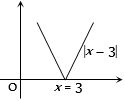
Trick : Can be seen by graph it is continuous but tangent is not defined at $x = 3$.
Need a full question paper?

Generate a complete, print-ready paper with questions like this in minutes — across 16+ boards, with answer keys.

Start Generating Free

Similar questions

Let Ajay will not appear in $\ce{JEE}$ exam with probability $p =\frac{2}{7}$, while both Ajay and Vijay will appear in the exam with probability $q =\frac{1}{5}$. Then the probability, that Ajay will appear in the exam and Vijay will not appear is :
Let $y=y(x)$ be the solution of the differential equation $\left(x^{2}+1\right) y^{\prime}-2 x y=\left(x^{4}+2 x^{2}+1\right) \cos x$, $y(0)=1$. Then $\int_{-3}^{3} y(x) d x$ is :
Order of the differential equation of the family of all concentric circles centered at $(h, k)$ is
Let $\overrightarrow{ a }, \overrightarrow{ b }, \overrightarrow{ c }$ be three coplanar concurrent vectors such that angles between any two of them is same. If the product of their magnitudes is $14$ and $(\vec{a} \times \vec{b}) \cdot(\vec{b} \times \vec{c})+(\vec{b} \times \vec{c}) \cdot(\vec{c} \times \vec{a})+(\vec{c} \times \vec{a}) \cdot(\vec{a} \times \vec{b})=168$ then $|\vec{a}|+|\vec{b}|+|\vec{c}|$ is equal to.
Set of values of $'\alpha '$ for which the angle bisector of the lines $(\alpha  + 1)x + 2y + 5 = 0$ and $4x + \alpha y -3 = 0$ containing origin is also the obtuse angle bisector, is
If $I = \int\limits_0^{\frac{\pi }{2}} {\cos \left( {\sin x} \right)} \,dx,J = \int\limits_0^{\frac{\pi }{2}} {\sin \left( {\cos x} \right)} \,dx$ and $K = \int\limits_0^{\frac{\pi }{2}} {\cos x} \,dx$ , then
Let $\alpha ,\,\,\beta ,\,\,\gamma $ be distinct real numbers. The points with position vectors $\alpha i + \beta j + \gamma k,\,\,\beta i + \gamma j + \alpha k,\,\,\gamma i + \alpha j + \beta k$
The shortest distance between the line $\frac{x-3}{4}=\frac{y+7}{-11}=\frac{z-1}{5}$ and $\frac{x-5}{3}=\frac{y-9}{-6}=\frac{z+2}{1}$
The function $f(x) = |px - q| + r|x|,$ $x \in ( - \infty ,\infty )$ where $p > 0,q > 0,r > 0$  assumes its minimum value only at one point if
If $f(x)\, = \frac{x}{{1 + |x|}}$ for $x \in R,$ then $f'(0) = $