MCQ
If $f(x) = x{e^{x(1 - x)}}$, then $f(x)$ is
  • Increasing on $\left[ { - {1 \over 2},\,1} \right]$
  • B
    Decreasing on $ R$
  • C
    Increasing on $ R$
  • D
    Decreasing on $\left[ { - {1 \over 2},1} \right]$

Answer

Correct option: A.
Increasing on $\left[ { - {1 \over 2},\,1} \right]$
a
(a) $f'(x) = {e^{x(1 - x)}} + x.{e^{x(1 - x)}}.(1 - 2x)$

$ = \,\,{e^{x(1 - x)}}\{ 1 + x(1 - 2x)\} = {e^{x(1 - x)}}.( - 2{x^2} + x + 1)$

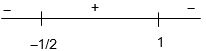
Now by the sign-scheme for $ - 2{x^2} + x + 1$

$f'(x) \ge 0,$ if $x\, \in \,\left[ { - \frac{1}{2},\,1} \right],$ because ${e^x}(1 - x)$ is always positive.

So, $f(x)$ is increasing on $\left[ { - \frac{1}{2},\,1} \right]$.
Need a full question paper?

Generate a complete, print-ready paper with questions like this in minutes — across 16+ boards, with answer keys.
Start Generating Free

Similar questions

If $a=\sin ^{-1}(\sin (5))$ and $b=\cos ^{-1}(\cos (5))$, then $a^2+b^2$ is equal to
The shortest distance between lines $L_1$ and $L_2$, where $L_1: \frac{x-1}{2}=\frac{y+1}{-3}=\frac{z+4}{2}$ and $L_2$ is the line passing through the points $A (-4,4,3) \cdot B (-1,6,3)$ and perpendicular to the line $\frac{x-3}{-2}=\frac{y}{3}=\frac{z-1}{1}$, is
If the line $2x + y + k = 0$ is normal to the parabola ${y^2} = - 8x$, then the value of $k$ will be
$\mathop {\lim }\limits_{x \to 0} \,\,\frac{{{{\log }_e}(1 + x)}}{{{3^x} - 1}} = $
$\mathop {Limit}\limits_{x \to \infty } \,\frac{{{{\cot }^{ - 1}}\left( {\sqrt {x + 1} \,\, - \,\sqrt x } \right)}}{{{{\sec }^{ - 1}}\left\{ {{{\left( {\frac{{2x + 1}}{{x - 1}}} \right)}^x}} \right\}}}$ is equal to
Let $y = y ( x )$ be the solution of the differential equation $x d y-y d x=\sqrt{\left(x^{2}-y^{2}\right)} d x, x \geq 1$, with $y (1)=0 .$ If the area bounded by the line $x =1, x = e ^{\pi}, y =0$ and $y = y ( x )$ is $\alpha e ^{2 \pi}+\beta$ then the value of $10(\alpha+\beta)$ is equal to ....... .
$\int_0^{\pi /2} {\frac{{\sin x}}{{\sin x + \cos x}}\,dx} $ equals
If $A$ and $B$ are square matrices of same order and $|B| \ne 0$ then $(B^{-1}AB)^5 =$
Let $B$ and $C$ be the two points on the line $y+x=0$ such that $B$ and $C$ are symmetric with respect to the origin. Suppose $A$ is a point on $y -2 x =2$ such that $\triangle ABC$ is an equilateral triangle. Then, the area of the $\triangle ABC$ is
The feasible solution for a $LPP$ is shown in Figure Let $z=3 x-4 y$ be the objective function. Minimum of $Z$ occurs at $....$