MCQ
If $f(x) = x{e^{x(1 - x)}}$, then $f(x)$ is
- ✓Increasing on $\left[ { - {1 \over 2},\,1} \right]$
- BDecreasing on $ R$
- CIncreasing on $ R$
- DDecreasing on $\left[ { - {1 \over 2},1} \right]$
$ = \,\,{e^{x(1 - x)}}\{ 1 + x(1 - 2x)\} = {e^{x(1 - x)}}.( - 2{x^2} + x + 1)$
Now by the sign-scheme for $ - 2{x^2} + x + 1$
$f'(x) \ge 0,$ if $x\, \in \,\left[ { - \frac{1}{2},\,1} \right],$ because ${e^x}(1 - x)$ is always positive.
So, $f(x)$ is increasing on $\left[ { - \frac{1}{2},\,1} \right]$.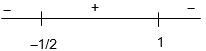
Generate a complete, print-ready paper with questions like this in minutes — across 16+ boards, with answer keys.
$(S_1)$ there exists $\mathrm{x}_{1}, \mathrm{x}_{2} \in(2,4), \mathrm{x}_{1}<\mathrm{x}_{2}$, such that $f^{\prime}\left(x_{1}\right)=-1$ and $f^{\prime}\left(x_{2}\right)=0$
$(S_2)$ there exists $\mathrm{x}_{3}, \mathrm{x}_{4} \in(2,4), \mathrm{x}_{3}<\mathrm{x}_{4}$, such that $f$ is decreasing in $\left(2, x_{4}\right)$, increasing in $\left(x_{4}, 4\right)$ and $2 f^{\prime}\left(x_{3}\right)=\sqrt{3} f\left(x_{4}\right)$.
Then
| | Number of cars manufactured | ||
| Colour | Vento | Creta | Wagonr |
| Red | 65 | 88 | 93 |
| White | 54 | 42 | 80 |
| Black | 66 | 52 | 88 |
| Sliver | 37 | 49 | 74 |