MCQ
If heat is supplied to a solid, its temperature:
  • A
    Must increase.
  • B
    May increase.
  • C
    May remain constant.
  • Both $B$ and $C$

Answer

Correct option: D.
Both $B$ and $C$

When heat is supplied to a solid, it is used up either to increase the temperature of the body or to change its state from one form to another by breaking the bonds between the molecules $($without raising the temperature$).$
When heat is supplied to the solid, the internal energy of the solid increases, so the temperature does not decrease.

Need a full question paper?

Generate a complete, print-ready paper with questions like this in minutes — across 16+ boards, with answer keys.
Start Generating Free

Similar questions

A diatomic gas $(\gamma=1.4)$ does $200 \mathrm{~J}$ of work when it is expanded isobarically. The heat given to the gas in the process is:
A wire can be broken by applying a load of $20\, kg$ weight. The force required to break the wire of twice the diameter is .......... $kg\, wt$
The period of a simple pendulum measured inside a stationary lift is found to be $T$. If the lift starts accelerating upwards with acceleration of $g/3,$ then the time period of the pendulum is
A boggy of uniformly moving train is suddenly detached from train and stops after covering some distance. The distance covered by the boggy and distance covered by the train in the same time has relation
A cylinder of mass $1\,kg$ is given heat of $20000\, J$ at atmospheric pressure. If initially temperature of cylinder is $20\,^oC$, then work done by the cylinder will be .......$J$ (Given that Specific heat of cylinder $= 400 \,J\, kg^{-1}$, Coefficient of volume expansion $= 9 \times {10^{-5}}\,^o C^{-1}$, Atmospheric pressure $= 10^5 \,N/m^2$ and density of cylinder $9000\,kg/m^3$)
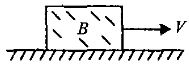
A block $B$ is pushed momentarily along a horizontal surface with an initial velocity $V.$ If $\mu $ is the coefficient of sliding friction between $B$ and the surface, block $B$ will come to rest after a time
$A$ solid uniform disk of mass $m$ rolls without slipping down a fixed inclined plane with an acceleration $a$. The frictional force on the disk due to surface of the plane is :
The graph of ln$\Big(\frac{\text{R}}{\text{R}_{\text{0}}}\Big)$ versus In A (R = radius of a nucleus and A - its mass number) is:
A particle experiences a constant acceleration for $20 \,sec$ after starting from rest. If it travels a distance ${S_1}$ in the first $10\, sec$ and a distance ${S_2}$ in the next $10 \,sec$, then
A spaceship in space sweeps stationary interplanetary dust. As a result, its mass increases at a rate $\frac{ dM ( t )}{ dt }= bv ^{2}( t ),$ where $v ( t )$ is its instantaneous velocity. The instantaneous acceleration of the satellite is