MCQ
If $(i)$ $C + {O_2} \to C{O_2}$, $(ii)$ $C + 1/2{O_2} \to CO$, $(iii)$ $CO + 1/2{O_2} \to C{O_2}$, the heats of reaction are $Q,\, - 12,\, - 10$ respectively. Then $Q = $
  • A
    $-2$
  • B
    $2$
  • $-22$
  • D
    $-16$

Answer

Correct option: C.
$-22$
(c)$C + {O_2} \to C{O_2}$; $\Delta H = q$
$C + 1/2{O_2} \to CO$; $\Delta H = - 12$ …..$(i)$
$CO + 1/2{O_2} \to C{O_2}$; $\Delta H = - 10$ …..$(ii)$
adding equation $(i)$ and $(ii)$ we can get
$\Delta H = - 12 + ( - 10) = - 22$

Need a full question paper?

Generate a complete, print-ready paper with questions like this in minutes — across 16+ boards, with answer keys.

Start Generating Free

Similar questions

The incorrect statement regarding above reactions is

$\mathop {Al}\limits_{metal} \xrightarrow[{(aq.)}]{{HCl}}'X' + Gas\,'P'$

$\mathop {Al}\limits_{metal} \xrightarrow[{ + {H_2}O}]{{NaOH\,(aq.)}}'Y' + Gas\,'Q'$

If the total energy of an electron in a hydrogen atom in an excited state is $-3.4\, eV$, then the de-Broglie wavelength of the electron is
An unknown alkene $(A)$ reacts with $3\, mole$ of $H_2$ gas in presence of  platinum catalyst to form $1$ -isopropyl- $4$ -methyl cyclohexane. When  unknown alkene $(A)$ is ozonized and reduced, following product are obtained 

$\begin{matrix}
   O  \\
   ||  \\
   H-C-H,  \\
\end{matrix}\begin{matrix}
   O\,\,\,\,\,\,\,\,\,\,\,\,\,\,\,\,\,\,\,\,\,\,\,\,\,\,\,O\,\,\,\,\,\,\,O\,\,\,\,  \\
   ||\,\,\,\,\,\,\,\,\,\,\,\,\,\,\,\,\,\,\,\,\,\,\,\,\,\,\,||\,\,\,\,\,\,\,\,\,||\,\,\,\,\,  \\
   H-C-C{{H}_{2}}-C-C-C{{H}_{3}},  \\
\end{matrix}\begin{matrix}
   \,\,\,\,\,O\,\,\,\,\,\,\,\,\,\,\,\,\,\,\,\,\,\,\,\,\,\,\,O  \\
   \,\,\,\,\,\,||\,\,\,\,\,\,\,\,\,\,\,\,\,\,\,\,\,\,\,\,\,\,\,\,\,\,||  \\
   C{{H}_{3}}-C-C{{H}_{2}}-C-H  \\
\end{matrix}$

aalkene $(A)$ will be  ?
Solid $NaCl$ is a bad conductor of electricity since
$CaCO_3 + 2HCl \to CaCl_2 + CO_2 + H_2O$ ; In this chemical reaction what will be the amount of calcium chloride when $10\,g$ calcium carbonate and $400\, mL\, 0.25\, M\, HCl$ is used .............. $\mathrm{g}$
The set representing the correct order of first ionisation potential is
Order of electron affinity of $F,\;Cl,\;Br$ and $I$ is .....
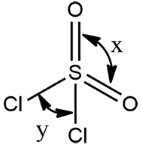
Compare $x$ and $y$  bond angles in the following molecule
If a carbon atom is attached to $ - H, - OH, - COOH$ and $ - OCO{C_2}{H_5}$ number of chiral $C -$ atoms in compound is
In which of the following equilibria, $\mathrm{K}_p$ and $\mathrm{K}_{\mathrm{c}}$ are $NOT$ equal?