If in an experiment for determination of velocity of sound by resonance tube method using a tuning fork of $512 Hz$, first resonance was observed at $30.7 cm$ and second was obtained at $63.2 cm$, then maximum possible error in velocity of sound is .....$cm/sec$ (consider actual speed of sound in air is $332 m/s$)
IIT 2005, Medium
Download our app for free and get started
(d) Using $\lambda = 2({l_2} - {l_1})$ ==> $v = 2n({l_2} - {l_1})$
==> $2 \times 512(63.2 - 30.7) = 33280cm/s$
Actual speed of sound ${v_0} = 332m/s = 33200cm/s$
Hence error $ = 33280 - 33200 = 80cm/s$

Download our appand get started for free
Experience the future of education. Simply download our apps or reach out to us for more information. Let's shape the future of learning together!No signup needed.*
Similar Questions
- 1A plane progressive wave is given by $y=2 \cos 2 \pi(330 t-x) m$. The frequency of the wave is:View Solution
- 2A uniform string oflength $20\ m$ is suspended from a rigid support. A short wave pulse is introduced at its lowest end. It starts moving up the string. The time taken to reach the supports is (take $g= 10 $ $ms^{-2}$ )View Solution
- 3The equation $y = 0.15\sin 5x\cos 300t$, describes a stationary wave. The wavelength of the stationary wave is .... $m$View Solution
- 4View SolutionIn the experiment to determine the speed of sound using a resonance column,
- 5An unknown frequency $x$ produces $8$ beats per seconds with a frequency of $250 Hz$ and $12$ beats with $270 Hz$ source, then $x$ is .... $Hz$View Solution
- 6A stretched wire of length $110 cm$ is divided into three segments whose frequencies are in ratio $1 : 2 : 3$. Their lengths must beView Solution
- 7The frequencies of two sound sources are $256 Hz$ and $260 Hz$. At $t = 0,$ the intensity of sound is maximum. Then the phase difference at the time $t = \frac{1}{16}\, sec$ will beView Solution
- 8${v_1}$ and ${v_2}$ are the velocities of sound at the same temperature in two monoatomic gases of densities ${\rho _1}$ and ${\rho _2}$ respectively. If $\frac{\rho _1}{\rho _2} = \frac{1}{4}$ then the ratio of velocities ${v_1}$ and ${v_2}$ will beView Solution
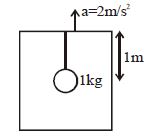
- 9In the figure shown a mass $1\ kg$ is connected to a string of mass per unit length $1.2\ gm/m$ . Length of string is $1\ m$ and its other end is connected to the top of a ceiling which is accelerating up with an acceleration $2\ m/s^2$ . A transverse pulse is produced at the lowest point of string. Time taken by pulse to reach the top of string is .... $s$View Solution
- 10The equation of the propagating wave is $y = 25\sin (20t + 5x),$ where $y$ is displacement. Which of the following statement is not trueView Solution