MCQ
If lateral magnification is $-2$ for virtual object for a spherical mirror then 
  • A
    Convex mirror, Real image
  • Convex mirror, Virtual image
  • C
    Concave mirror, Real image
  • D
    Concave mirror, Virtual image

Answer

Correct option: B.
Convex mirror, Virtual image
b
Sine magnification is $-2$ so virtual object have virtual image.
virtual object to virtual image then mirror is convex.

Need a full question paper?

Generate a complete, print-ready paper with questions like this in minutes — across 16+ boards, with answer keys.
Start Generating Free

Similar questions

The current sensitivity of a moving coil galvanometer can be increased by
In a single slit diffraction of light of wavelength $\lambda$ by a slit of width $ e$, the size of the central maximum on a screen at a distance $b$  is
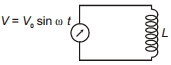
There is no resistance in the inductive circuit. Kirchhoff 's voltage law for the circuit is
The maximum intensity of fringes in Young's experiment is I. If one of the slit is closed, then the intensity at that place becomes $I_o$. Which of the following relation is true ?
Colours of thin films result from or On a rainy day, a small oil film on water show brilliant colours. This is due to
The de Broglie wavelengths of a proton and an $\alpha$ particle are $\lambda$ and $2 \lambda$ respectively. The ratio of the velocities of proton and $\alpha$ particle will be :
In a semiconductor, the concentration of electrons is $8 \times {10^{14}}/c{m^3}$ and that of the holes is $5 \times {10^{12}}c{m^3}.$ The semiconductor is
A convex lens is in contact with concave lens. The magnitude of the ratio of their focal length is $2/3.$ Their equivalent focal length is $30 cm.$ What are their individual focal lengths
Highly excited states for hydrogen-like atoms (also called Rydberg states) with nuclear charge $Z e$ are defined by their principal quantum number $n$, where $n \gg 1$. Which of the following statement($s$) is(are) true?

($A$) Relative change in the radii of two consecutive orbitals does not depend on $Z$

($B$) Relative change in the radii of two consecutive orbitals varies as $1 / n$

($C$) Relative change in the energy of two consecutive orbitals varies as $1 / n^3$

($D$) Relative change in the angular momenta of two consecutive orbitals varies as $1 / n$

Gauss's law is valid for: