MCQ
Gauss's law is valid for:
  • Any closed surface.
  • B
    Only regular close surfaces.
  • C
    Any open surface.
  • D
    Only irregular open surfaces.

Answer

Correct option: A.
Any closed surface.

Need a full question paper?

Generate a complete, print-ready paper with questions like this in minutes — across 16+ boards, with answer keys.
Start Generating Free

Similar questions

Which of the following particle has similar mass to electron
A $60\, watt$ bulb carries a current of $0.5\, amp$. The total charge passing through it in $1$ hour is ............ $coulomb$
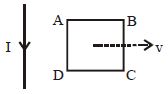
A metallic frame moves with constant velocity $v$ near a infinite length current carrying  wire. At any instant induced emf in sides $AD$ and $BC$ are $5\,V$ and  $2\,V$ respectively. If resistance of frame is $6\,\Omega$ then magnitude and direction of induced current in it 
An X-ray tube with a copper target emits Cu $K_\alpha$ line of wavelength 1.50 Å. What should be the minimum voltage through which electrons are to be accelerated to produce this wavelength of X rays $(h = 6.63\times 10^{-34} \mathrm{~J}-\mathrm{sec}, \mathrm{c}=3 \times 10^8 \mathrm{~m} / \mathrm{s})$ 
Which one of the following statement is false:
The direction of poynting vector represents
Electric potential at an equatorial point of a small dipole with dipole moment P (r, distance from the dipole) is
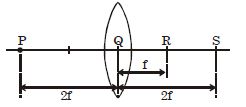
The diagram below shows an object placed at a distance $2f$ in front of a convex lens of focal length $f.$ Which of the following may represents the positions of the image when $(i)$ a parallel sides glass block, or $(ii)$ a converging lens of long focal length is inserted between the object and the convex lens?

Glass block inserted                                         Converging lens inserted                                            
In a negative logic the following wave form corresponds to the
A ray of light travelling in the direction $\frac{1}{2}(\hat{i}+\sqrt{3} \hat{j})$ is incident on a plane mirror. After reflection, it travels along the direction $\frac{1}{2}(\hat{i}-\sqrt{3 \hat{j}})$. The angle of incidence is: