MCQ
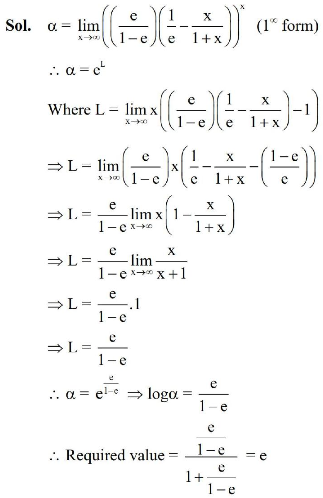
If $\lim _{x \rightarrow \infty}\left(\left(\frac{e}{1-e}\right)\left(\frac{1}{e}-\frac{x}{1+x}\right)\right)^x=\alpha$, then the value of $\frac{\log _{ e } \alpha}{1+\log _{ e } \alpha}$ equals :
- Ae
- B$e ^{-2}$
- C$e^2$
- D$e^{-1}$
Generate a complete, print-ready paper with questions like this in minutes — across 16+ boards, with answer keys.
($A$) $f$ has a local minimum at $x=2$
($B$) fhas a local maximum at $x=2$
($C$) $f^{\prime \prime}(2)>f(2)$
($D$) $f(x)-f^{\prime \prime}(x)=0$ for at least one $x \in \mathbb{R}$