MCQ 14 Marks
The area of the region enclosed by the curves $y=x^2-4 x+4$ and $y^2=16-8 x$ is :
- ✓
$\frac{8}{3}$
- B
$\frac{4}{3}$
- C
- D
AnswerCorrect option: A. $\frac{8}{3}$
(A) $\frac{8}{3}$
Sol.
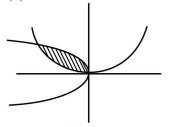
$\begin{array}{l}y=(x-2)^2, y^2=8(x-2) \\ y=x^2, y^2=-8 x \\ =\frac{16 a b}{3}=\frac{16 \times \frac{1}{4} \times 2}{3}=\frac{8}{3}\end{array}$ View full question & answer→MCQ 24 Marks
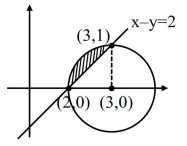
Let the curve $z(1+i)+\bar{z}(1-i)=4, z \in C$, divide the region $|z-3| \leq 1$ into two parts of areas $\alpha$ and $\beta$. Then $|\alpha-\beta|$ equals :
- A
$1+\frac{\pi}{2}$
- B
$1+\frac{\pi}{3}$
- C
$1+\frac{\pi}{4}$
- D
$1+\frac{\pi}{6}$
View full question & answer→MCQ 34 Marks
The sum of all values of $\theta \in[0,2 \pi]$ satisfying $2 \sin ^2 \theta=\cos 2 \theta$ and $2 \cos ^2 \theta=3 \sin \theta$ is
- A
$\frac{\pi}{2}$
- B
$4 \pi$
- C
$\frac{5 \pi}{6}$
- ✓
$\pi$
Answer(D) $\pi$
$
\begin{array}{l}Sol.\
2 \sin ^2 \theta=\cos 2 \theta \\
2 \sin ^2 \theta=1-2 \sin ^2 \theta \\
4 \sin ^2 \theta=1 \\
\sin ^2 \theta=\frac{1}{4} \\
\sin \theta= \pm \frac{1}{2} \\
2 \cos ^2 \theta=3 \sin \theta \\
2-2 \sin ^2 \theta+3 \sin \theta-2=0 \\
(2 \sin \theta-1)(2 \sin \theta-2)=0 \\
\sin \theta=\frac{1}{2}
\end{array}
$
so common equation which satisfy both equations is $\sin \theta=\frac{1}{2}$
$\theta=\frac{\pi}{6}, \frac{5 \pi}{6} \quad(\theta \in[0,2 \pi])$
$\operatorname{Sum}-\pi$
View full question & answer→MCQ 44 Marks
If $A$ and $B$ are two events such that $P(A \cap B)=0.1$, and $P(A \mid B)$ and $P(B \mid A)$ are the roots of the equation $12 x^2-7 x+1=0$, then the value of $\frac{ P (\overline{ A } \cup \overline{ B })}{ P (\overline{ A } \cap \overline{ B })}$ is:
- A
$\frac{5}{3}$
- B
$\frac{4}{3}$
- ✓
$\frac{9}{4}$
- D
$\frac{7}{4}$
AnswerCorrect option: C. $\frac{9}{4}$
(C) $\frac{9}{4}$
$
\begin{array}{l}Sol.\
12 x^2-7 x+1=0 \\
x=\frac{1}{3}, \frac{1}{4} \\
\text { Let } P\left(\frac{A}{B}\right)=\frac{1}{3} \& P\left(\frac{B}{A}\right)=\frac{1}{4} \\
\frac{P(A \cap B)}{P(B)}=\frac{1}{3} \& \frac{P(A \cap B)}{P(A)}=\frac{1}{4} \\
\Rightarrow P(B)=0.3 \\
\& P(A)=0.4 \\
P(A \cup B)=P(A)+P(B)-P(A \cap B) \\
=0.3+0.4-0.1=0.6 \\
\text { Now } \frac{P(\overline{A} \cup \bar{B})}{P(\overline{A} \cap \overline{B})}=\frac{P(\overline{A \cap B})}{P(\overline{A \cup B})} \\
=\frac{1-P(A \cap B)}{1-P(A \cup B)}=\frac{1-0.1}{1-0.6}=\frac{9}{4}
\end{array}
$
View full question & answer→MCQ 54 Marks
Let $E : \frac{ x ^2}{ a ^2}+\frac{ y ^2}{b^2}=1, a > b$ and $H : \frac{ x ^2}{A^2}-\frac{ y ^2}{B^2}=1$. Let the distance between the foci of E and the foci of H be $2 \sqrt{3}$. If $a - A =2$, and the ratio of the eccentricities of E and H is $\frac{1}{3}$, then the sum of the lengths of their latus rectums is equal to:
Answer(C) 8
Sol. $\frac{x^2}{a^2}+\frac{y^2}{b^2}=1$ foci are (ae, 0$)$ and $(-a e, 0)$
$\frac{ x ^2}{A^2}+\frac{ y ^2}{B^2}=1$ foci are $\left( Ae ^{\prime}, 0\right)$ and ( $- Ae ^{\prime}, 0$ )
$
\begin{array}{l}
\Rightarrow 2 ae=2 \sqrt{3} \Rightarrow ae=\sqrt{3} \\
\text { and } 2 Ae^{\prime}=2 \sqrt{3} \Rightarrow Ae^{\prime}=\sqrt{3} \\
\Rightarrow ae=Ae^{\prime} \Rightarrow \frac{e}{e^{\prime}}=\frac{A}{a} \\
\Rightarrow \frac{1}{3}=\frac{A}{a} \Rightarrow a=3 A
\end{array}
$
$\begin{array}{l}\text { Now } a - A =2 \Rightarrow a -\frac{ a }{3}-2 \Rightarrow a =3 \text { and } A =1 \\ Ae =\sqrt{3} \Rightarrow e =\frac{1}{\sqrt{3}} \text { and } e ^{\prime}=\sqrt{3} \\ b^2= a ^2\left(1- e ^2\right) \\ b ^2=6 \\ \text { and } B ^2= A ^2\left(\left( e ^{\prime}\right)^2-1\right)=(2) \Rightarrow B ^2=2 \\ \text { sum of } LR =\frac{2 b^2}{ a }+\frac{2 B^2}{A}=8\end{array}$
View full question & answer→MCQ 64 Marks
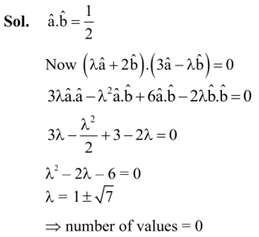
Let $\vec{a}$ and $\vec{b}$ be two unit vectors such that the angle between them is $\frac{\pi}{3}$. If $\lambda \vec{a}+2 \vec{b}$ and $3 \vec{a}-\lambda \vec{b}$ are perpendicular to each other, then the number of values of $\lambda$ in $[-1,3]$ is :
View full question & answer→MCQ 74 Marks
If the system of linear equations :
$
\begin{array}{l}
x+y+2 z=6, \\
2 x+3 y+a z=a+1, \\
-x-3 y+b z=2 b,
\end{array}
$
where $a , b \in R$, has infinitely many solutions, then $7 a+3 b$ is equal to :
Answer(C) 16
$
\begin{array}{l}Sol.\
\Delta=\left|\begin{array}{ccc}
1 & 1 & 2 \\
2 & 3 & a \\
-1 & -3 & b
\end{array}\right|=0 \\
\Rightarrow 2 a+b-6=0\qquad\ldots(1) \\
\Delta_1=\left|\begin{array}{ccc}
1 & 1 & 6 \\
2 & 3 & a+1 \\
-1 & -3 & 2 b
\end{array}\right|=0 \\
\Rightarrow a+b-8=0 \qquad\ldots(2)\\
\text { Solving }(1)+(2) \\
a=-2, b=10 \\
\Rightarrow 7 a+3 b=16
\end{array}
$
View full question & answer→MCQ 84 Marks
Let $A =\{1,2,3,4\}$ and $B =\{1,4,9,16\}$. Then the number of many-one functions $f: A \rightarrow B$ such that $1 \in f(A)$ is equal to :
Answer(B) 151
$\begin{array}{ll}\text { Sol. } \text { Total }=4^4 \\ \text { One-one }=4! \\ \text { Many-one }=256-24=232 \\ \text { Many-one which } 1 \notin f(A) \\ =3.3 .3 .3=81 \\ 232-81=151\end{array}$
View full question & answer→MCQ 94 Marks
Let $\alpha_0$ and $\beta_0$ be the distinct roots of $2 x^2+(\cos \theta) x-1=0, \theta \in(0,2 \pi)$. If $m$ and $M$ are the minimum and the maximum values of $\alpha_0^4+\beta_0^4$, then $16( M + m )$ equals :
Answer(B) 25
$\begin{array}{l}Sol.\left(\alpha^2+\beta^2\right)^2-2 \alpha^2 \beta^2 \\ {\left[(\alpha+\beta)^2-2 \alpha \beta\right]^2-2(\alpha \beta)^2} \\ {\left[\frac{\cos ^2 \theta}{4}+1\right]^2-2 \cdot \frac{1}{4}} \\ \left(\frac{\cos ^2 \theta}{4}+1\right)^2-\frac{1}{2} \\ M =\frac{25}{16}-\frac{1}{2}=\frac{17}{16} \\ m=\frac{1}{2}, 16( M + m )=25\end{array}$
View full question & answer→MCQ 104 Marks
If $\int e^x\left(\frac{x \sin ^{-1} x}{\sqrt{1-x^2}}+\frac{\sin ^{-1} x}{\left(1-x^2\right)^{3 / 2}}+\frac{x}{1-x^2}\right) d x=g(x)+C$, where C is the constant of integration, then $g \left(\frac{1}{2}\right)$ equals :
- A
$\frac{\pi}{6} \sqrt{\frac{ e }{2}}$
- B
$\frac{\pi}{4} \sqrt{\frac{ e }{2}}$
- ✓
$\frac{\pi}{6} \sqrt{\frac{ e }{3}}$
- D
$\frac{\pi}{4} \sqrt{\frac{ e }{3}}$
AnswerCorrect option: C. $\frac{\pi}{6} \sqrt{\frac{ e }{3}}$
(C) $\frac{\pi}{6} \sqrt{\frac{ e }{3}}$
$
\begin{array}{l}Sol\
\because \frac{d}{d x}\left(\frac{x \sin ^{-1} x}{\sqrt{1-x^2}}\right)=\frac{\sin ^{-1} x}{\left(1-x^2\right)^{3 / 2}}+\frac{x}{1-x^2} \\
\Rightarrow \int e^x\left(\frac{x \sin ^{-1} x}{\sqrt{1-x^2}}+\frac{\sin ^{-1} x}{\left(1-x^2\right)^{3 / 2}}+\frac{x}{1-x^2}\right) dx \\
=e^x \cdot \frac{x \sin ^{-1} x}{\sqrt{1-x^2}}+c=g(x)+C
\end{array}
$
Note : assuming $g(x)=\frac{ xe ^{ x } \sin ^{-1} x }{\sqrt{1- x ^2}}$
$g(1 / 2)=\frac{e^{1 / 2}}{2} \cdot \frac{\frac{\pi}{6} \times 2}{\sqrt{3}}=\frac{\pi}{6} \sqrt{\frac{e}{3}}
$
Comment : In this question we will not get a unique function $g(x)$, but in order to match the answer we will have to assume $g(x)=\frac{x e^x \sin ^{-1} x}{\sqrt{1-x^2}}$.
View full question & answer→MCQ 114 Marks
If $x=f(y)$ is the solution of the differential equation$
\left(1+y^2\right)+\left(x-2 e^{\tan ^{-1} y}\right) \frac{d y}{d x}=0, y \in\left(-\frac{\pi}{2}, \frac{\pi}{2}\right)
$with $f(0)=1$, then $f\left(\frac{1}{\sqrt{3}}\right)$ is equal to :
- A
$e^{\pi / 4}$
- B
$e^{\pi / 12}$
- C
$e ^{\pi / 3}$
- ✓
$e^{\pi / 6}$
AnswerCorrect option: D. $e^{\pi / 6}$
(D) $e^{\pi /6}$
$
\begin{array}{l}Sol.\
\frac{d x}{d y}+\frac{x}{1+y^2}=\frac{2 e^{\tan ^{-1} y}}{1+y^2} \\
\text { I.F. }=e^{\tan ^{-1} y} \\
x^{\tan ^{-1} y}=\int \frac{2\left(e^{\tan ^{-1} y}\right)^2 d y}{1+y^2} \\
\text { Put } \tan ^{-1} y=t, \frac{d y}{1+y^2}=d t \\
x e^{\tan ^{-1} y}=\int 2 e^{2t} d t \\
x e^{\tan ^{-1} y}=e^{2 \tan ^{-1} y}+c \\
x=e^{\tan ^{-1} y}+\operatorname{ce}^{-\tan ^{-1} y} \\
\because y=0, x=1 \\
1=1+c \Rightarrow c=0 \\
y=\frac{1}{\sqrt{3}}, x=e^{\pi / 6}
\end{array}
$
View full question & answer→MCQ 124 Marks
The perpendicular distance, of the line $\frac{x-1}{2}=\frac{y+2}{-1}=\frac{z+3}{2}$ from the point $P(2,-10,1)$, is:
- A
- B
$5 \sqrt{2}$
- ✓
$3 \sqrt{5}$
- D
$4 \sqrt{3}$
AnswerCorrect option: C. $3 \sqrt{5}$
(C) $3 \sqrt{5}$
Sol.
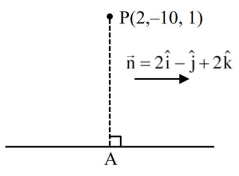
$\begin{array}{l}\frac{ x -1}{2}=\frac{ y +2}{-1}=\frac{ z +3}{2}=\lambda \text { (let) } \\ (2 \lambda+1,-\lambda-2,2 \lambda-3) \\ \because \overrightarrow{ PA } \cdot \overrightarrow{ n }=0 \\ \Rightarrow(2 \lambda-1) 2+(-\lambda+8)(-1)+(2 \lambda-4) 2=0 \\ \Rightarrow 4 \lambda-2+\lambda-8+4 \lambda-8=0 \\ \Rightarrow 9 \lambda-18=0 \Rightarrow \lambda=2 \\ \therefore A(5,-4,1) \\ \therefore AP =\sqrt{3^2+6^2+0^2}=\sqrt{45}=3 \sqrt{5}\end{array}$ View full question & answer→MCQ 134 Marks
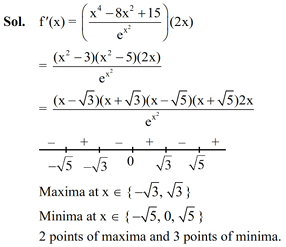
Let $f(x)=\int_0^{x^2} \frac{t^2-8 t+15}{e^t} d t, x \in R$. Then the numbers of local maximum and local minimum points of $f$, respectively, are :
View full question & answer→MCQ 144 Marks
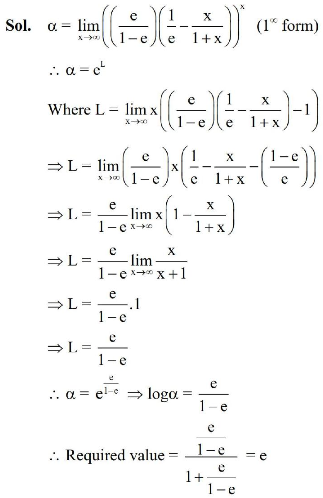
If $\lim _{x \rightarrow \infty}\left(\left(\frac{e}{1-e}\right)\left(\frac{1}{e}-\frac{x}{1+x}\right)\right)^x=\alpha$, then the value of $\frac{\log _{ e } \alpha}{1+\log _{ e } \alpha}$ equals :
- A
- B
$e ^{-2}$
- C
$e^2$
- D
$e^{-1}$
View full question & answer→MCQ 154 Marks
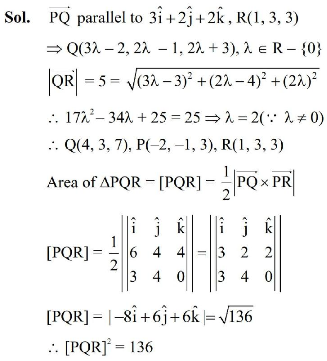
Let a line pass through two distinct points $P(-2,-1,3)$ and $Q$, and be parallel to the vector $3 \hat{i}+2 \hat{j}+2 k$. If the distance of the point $Q$ from the point $R (1,3,3)$ is 5 , then the square of the area of $\triangle PQR$ is equal to:
View full question & answer→MCQ 164 Marks
Suppose that the number of terms in an A.P. is 2 k, $k \in N$. If the sum of all odd terms of the A.P. is 40, the sum of all even terms is 55 and the last term of the A.P. exceeds the first term by 27, then k is equal to
Answer(A) 5
Sol.
$a_1, a_2, a_3, \ldots \ldots, a_{2 k} \quad \rightarrow_{\text {A.P. }}$
$\sum_{\mathrm{r}=1}^{\mathrm{k}} \mathrm{a}_{2 \mathrm{r}-1}=40, \sum_{\mathrm{r}=1}^{\mathrm{k}} \mathrm{a}_{2 \mathrm{r}}=55, \mathrm{a}_{2 \mathrm{k}}-\mathrm{a}_{1}=27$
$\frac{\mathrm{k}}{2}\left[2 \mathrm{a}_{1}+(\mathrm{k}-1) 2 \mathrm{~d}\right]=40, \frac{\mathrm{k}}{2}\left[2 \mathrm{a}_{2}+(\mathrm{k}-1) 2 \mathrm{~d}\right]=55$,
$\begin{array}{l} d =\frac{27}{2 k -1} \\ a _1=\frac{40}{ k }-( k -1) d =\frac{55}{ k }- kd \\ d =\frac{15}{ k } \Rightarrow \frac{27}{2 k -1}=\frac{15}{ k } \Rightarrow 9 k =10 k -5 \\ \therefore k =5\end{array}$
View full question & answer→MCQ 174 Marks
For a $3 \times 3$ matrix M, let trace (M) denote the sum of all the diagonal elements of M. Let A be a $3 \times 3$ matrix such that $|A|=\frac{1}{2}$ and trace $(A)=3$. If $B=\operatorname{adj}(\operatorname{adj}(2 A))$, then the value of $|B|+$ trace $(B)$ equals:
Answer(D) 280
$\begin{array}{l}\text { Sol. }| A |=\frac{1}{2}, \operatorname{trace}(A)=3, B=\operatorname{adj}(\operatorname{adj}(2 A))=|2 A|^{n-2}(2 A) \\ n =3, B=|2 A|(2 A)=2^3 \cdot|A|(2 A)=8 A \\ | B |=|8 A|=8^3 \cdot|A|=2^8=256 \\ \operatorname{trace}(B)=8 \operatorname{trace}(A)=24 \\ |B|+\operatorname{trace}( B )=280\end{array}$
View full question & answer→MCQ 184 Marks
Let $P (4,4 \sqrt{3})$ be a point on the parabola $y ^2=4 ax$ and PQ be a focal chord of the parabola. If M and N are the foot of perpendiculars drawn from P and Q respectively on the directrix of the parabola, then the area of the quadrilateral PQMN is equal to:
- A
$\frac{263 \sqrt{3}}{8}$
- B
$17 \sqrt{3}$
- C
$\frac{343 \sqrt{3}}{8}$
- D
$\frac{34 \sqrt{3}}{3}$
View full question & answer→MCQ 194 Marks
In a group of 3 girls and 4 boys, there are two boys $B_1$ and $B_2$. The number of ways, in which these girls and boys can stand in a queue such that all the girls stand together, all the boys stand together, but $B_1$ and $B_2$ are not adjacent to each other, is :
Answer(A) 144
Sol. Total - when $B_1$ and $B_2$ are together
$
=2!(3!4!)-2!(3!(3!2!))=144
$
View full question & answer→MCQ 204 Marks
Let $\alpha, \beta, \gamma$ and $\delta$ be the coefficients of $x^7, x^5, x^3$ and $x$ respectively in the expansion of $\left(x+\sqrt{x^3-1}\right)^5+\left(x-\sqrt{x^3-1}\right)^5, x>1$. If $u$ and $v$ satisfy the equations
$
\begin{array}{l}
\alpha u+\beta v=18, \\
\gamma u+\delta v=20,
\end{array}
$
then $u+v$ equals :
Answer(A) 5
$
\begin{array}{l}Sol.\
\left(x+\sqrt{x^3-1}\right)^5+\left(x-\sqrt{x^3-1}\right)^5 \\
=2\left\{^5 C_0 x^5+{ }^5 C_2 x^3\left(x^3-1\right)+{ }^5 C_4 .x\left(x^3-1\right)^2\right\} \\
=2\left\{5 x^7+10 x^6+x^5-10 x^4-10 x^3+5 x\right\} \\
\Rightarrow \alpha=10, \beta=2, \gamma=-20, \delta=10
\end{array}
$
Now, $10 u +2 v =18$
$
\begin{array}{l}
-20 u+10 v=20 \\
\Rightarrow u=1, v=4 \\
u+v=5
\end{array}
$
View full question & answer→