MCQ
If momentum is increased by $20 \%$, then K.E. increases by
  • $44 \%$
  • B
    $55 \%$
  • C
    $66 \%$
  • D
    $77 \%$

Answer

Correct option: A.
$44 \%$
(a)
$E=\frac{P^2}{2 m} $. If  $m$ is constant then
$E \propto P^2 \Rightarrow \frac{E_2}{E_1}=\left(\frac{P_2}{P_1}\right)^2=\left(\frac{1.2P}{P}\right)^2=1.44 $
$\Rightarrow E_2=1.44 E_1=E_1+0.44 E_1 $
$E_2=E_1+44 \% \text { of }E_1$
i.e.the kinetic energy will increase by $44 \%$

Need a full question paper?

Generate a complete, print-ready paper with questions like this in minutes — across 16+ boards, with answer keys.
Start Generating Free

Similar questions

The Rutherford $\alpha$-particle experiment shows that most of the $\alpha$ particles pass through almost unscattered while some are scattered through large angles. What information does it give about the structure of the atom
Pressure gradient has the same dimension as that of
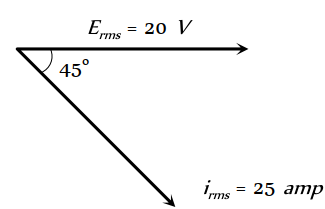
The vector diagram of current and voltage for a circuit is as shown. The components of the circuit will beImage
If the wavelength of light is $4000\ \mathring A$, then the number of waves in 1 mm length will be
liquid oxygen remains suspended between two pole faces of a magnet because it is
If an electron revolves in the path of a circle of radius of $0.5 \times 10$ $\mathrm{m}$ at frequency of $5 \times 10^{-} \mathrm{cycles} / \mathrm{s}$ the electric current in the circle is (Charge of an electron $=1.6 \times 10^{-19} C$ )
A spring is stretched by $0.20 m$, when a mass of $0.50 kg$ is suspended. When a mass of $0.25 kg$ is suspended, then its period of oscillation will be $\left(g=10 m / s ^2\right)$
In Milikan's oil drop experiment, a charged drop falls with terminal velocity $V$. If an electric field $E$ is applied in vertically upward direction then it starts moving in upward direction with terminal velocity $2 \mathrm{~V}$. If magnitude of electric field is decreased to $\frac{E}{2}$, then terminal velocity will become
An $L C R$ series circuit with a resistance of $100 ohm$ is connected to an ac source of $200 V($ r.m.s. $)$ and angular frequency $300 rad / s$. When only the capacitor is removed, the current lags behind the voltage by $60^{\circ}$. When only the inductor is removed the current leads the voltage by $60^{\circ}$. The average power dissipated is
The ratio of densities of nitrogen and oxygen is $14:16.$ The temperature at which the speed of sound in nitrogen will be same at that in oxygen at $55 {}^\circ\mathrm{C}$ is