If $n$ represents the actual number of deflections in a converted galvanometer of resistance $G$ and shunt resistance $S$. Then the total current I when its figure of merit is $K$ will be
JEE MAIN 2022, Medium
Download our app for free and get started
Figure of merit $\frac{ I _{ g }}{\theta}= K$
$I _{ g }= Kn$
$I =\frac{ I _{ g }}{ s }( G + S )$
$I =\frac{ nK }{ S }( G + S )$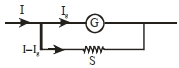

Download our appand get started for free
Experience the future of education. Simply download our apps or reach out to us for more information. Let's shape the future of learning together!No signup needed.*
Similar Questions
- 1A proton moving with a velocity, $2.5 \times {10^7}\,m/s$, enters a magnetic field of intensity $2.5\,T$ making an angle ${30^o}$ with the magnetic field. The force on the proton isView Solution
- 2For a moving coil galvanometer, the deflection in the coil is $0.05\,rad$ when a current of $10\,mA$ is passed through it. If the torsional constant of suspension wire is $4.0 \times 10^{-5}\,Nm\,rad ^{-1}$, the magnetic field is $0.01\,T$ and the number of turns in the coil is $200$,the area of each turn (in $cm ^2$ ) is :View Solution
- 3A moving coil galvanometer has resistance $50\,\Omega $ and it indicates full deflection at $4\,mA$ current. A voltmeter is made using this galvanometer and a $5\,k\Omega $ resistance. The maximum voltage, that can be measured using this voltamenter, will be close to ......$V$View Solution
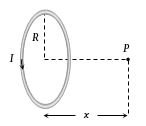
- 4A coil having $N$ $turns$ carry a current $I$ as shown in the figure. The magnetic field intensity at point $P$ isView Solution
- 5View SolutionAssertion : Voltmeter is connected in parallel with the circuit.
Reason : Resistance of a voltmeter is very large.
- 6An $\alpha$-particle (mass $4 amu$ ) and a singly charged sulfur ion (mass $32 amu$ ) are initially at rest. They are accelerated through a potential $V$ and then allowed to pass into a region of uniform magnetic field which is normal to the velocities of the particles. Within this region, the $\alpha$-particle and the sulfur ion move in circular orbits of radii $r_\alpha$ and $r_5$, respectively. The ratio $\left(r_s / r_\alpha\right)$ is. . . . .$(4)$View Solution
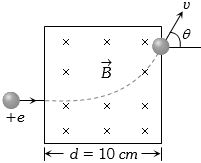
- 7A proton accelerated by a potential difference $500\;KV$ moves though a transverse magnetic field of $0.51\;T$ as shown in figure. The angle $\theta $through which the proton deviates from the initial direction of its motion is......$^o$View Solution
- 8A long straight wire carries a current along the $x$-axis. Consider the points $A(0, 1, 0), B(0, 1, 1), C(1, 0, 1)$ and $D(1, 1, 1)$. Which of the following pairs of points will have magnetic fields of the same magnitude?View Solution
- 9View SolutionA stream of electrons is projected horizontally to the right. A straight conductor carrying a current is supported parallel to electron stream and above it. If the current in the conductor is from left to right then what will be the effect on electron stream
- 10In a mass spectrometer used for measuring the masses of ions, the ions are initially accelerated by an electric potential $V$ and then made to describe semicircular paths of radius $R$ using a magnetic field $B$. If $V$ and $B$ are kept constant, the ratio $\left( {\frac{{{\text{charge on the ion}}}}{{{\text{mass of the ion}}}}} \right)$ will be proportional toView Solution