A proton moving with a velocity, $2.5 \times {10^7}\,m/s$, enters a magnetic field of intensity $2.5\,T$ making an angle ${30^o}$ with the magnetic field. The force on the proton is
Medium
Download our app for free and get started
$F = qvB\sin \theta = 1.6 \times {10^{ - 19}} \times 2.5 \times 2.5 \times {10^7}\sin {30^o}$
$F = 1.6 \times {10^{ - 19}} \times 6.25 \times {10^7} \times \frac{1}{2} = 5 \times {10^{ - 12}}\,N$
$F = 1.6 \times {10^{ - 19}} \times 6.25 \times {10^7} \times \frac{1}{2} = 5 \times {10^{ - 12}}\,N$

Download our appand get started for free
Experience the future of education. Simply download our apps or reach out to us for more information. Let's shape the future of learning together!No signup needed.*
Similar Questions
- 1Force on current carrying loop (Radius $= R$ ) in uniform magnetic $(B)$ field which is at an angle $30^{\circ}$ with the normal will beView Solution
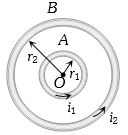
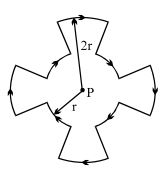
- 2A current $I$ flows around a closed path in the horizontal plane of the circle as shown in the figure. The path consists of eight arcs with alternating radii $r$ and $2r$. Each segment of arc subtends equal angle at the common centre $P.$ The magnetic field produced by current path at point $P$ isView Solution
- 3A $3.0\; cm$ wire carrying a current of $10 \;A$ is placed inside a solenoid perpendicular to its axis. The magnetic field inside the solenoid is given to be $0.27\; T$. What is the magnetic force on the wire?View Solution
- 4A particle of charge $q$ and mass $m$ moving with a velocity $v$ along the $x$-axis enters the region $x > 0$ with uniform magnetic field $B$ along the $\hat k$ direction. The particle will penetrate in this region in the $x$-direction upto a distance $d$ equal toView Solution
- 5A particle of charge $q$ and mass $m$ moving with a velocity $v$ along the $x$-axis enters the region $x > 0$ with uniform magnetic field $B$ along the $\hat k$ direction. The particle will penetrate in this region in the $x$-direction upto a distance $d$ equal toView Solution
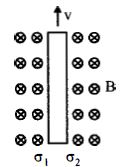
- 6Consider a thin metallic sheet perpendicular to the plane of the paper moving with speed $'v'$ in a uniform magnetic field $B$ going into the plane of the paper (See figure). If charge densities ${\sigma _1}$ and ${\sigma _2}$ are induced on the left and right surfaces, respectively, of the sheet then (ignore fringe effects)View Solution
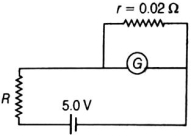
- 7In the circuit, shown the galvanometer $G$ of resistance $60\, \Omega$ is shunted by a resistance $r=0.02\, \Omega$. The current through $R$ (in $ohm$) is nearly $1\, A$. The value of resistance $R$ (in $ohm$) is nearly (in $\Omega$)View Solution
- 8Two coaxial solenoids of different radii carry current $I$ in the same direction. Let $\;{\overrightarrow {\;F} _1}$ be the magnetic force on the inner solenoid due to the outer one and $\;{\overrightarrow {\;F} _2}$ be the magnetic force on the outer solenoid due to the inner one. ThenView Solution
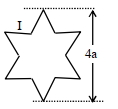
- 9A symmetric star conducting wire loop is carrying a steady state current $\mathrm{I}$ as shown in figure. The distance between the diametrically opposite vertices of the star is $4 a$. The magnitude of the magnetic field at the center of the loop isView Solution
- 10$A$ and $B$ are two concentric circular conductors of centre $O$ and carrying currents ${i_1}$ and ${i_2}$ as shown in the adjacent figure. If ratio of their radii is $1 : 2$ and ratio of the flux densities at $O$ due to $A$ and $B$ is $1 : 3$, then the value of ${i_1}/{i_2}$ isView Solution