If ${n_1},{n_2},{n_3}.........$ are the frequencies of segments of a stretched string, the frequency $n$ of the string is given by
Medium
Download our app for free and get started
(c) For a vibrating string
${n_1}{l_1} = {n_2}{l_2} = {n_3}{l_3}..... = $constant $= k$ (say) $= nl$
Also ${l_1} + {l_2} + {l_3} + {l_4} + ...... = 1$
$\frac{k}{{{n_1}}} + \frac{k}{{{n_2}}} + \frac{k}{{{n_3}}} + \frac{k}{{{n_4}}} + .... = \frac{k}{n}$==> $\frac{1}{n} = \frac{1}{{{n_1}}} + \frac{1}{{{n_2}}} + \frac{1}{{{n_3}}} + .......$

Download our appand get started for free
Experience the future of education. Simply download our apps or reach out to us for more information. Let's shape the future of learning together!No signup needed.*
Similar Questions
- 1The frequency of the first harmonic of a string stretched between two points is $100 Hz$. The frequency of the third overtone is ... $Hz$View Solution
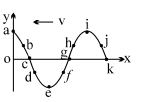
- 2The figure represents the instantaneous picture of a longitudinal harmonic wave travelling along the negative $x$-axis. Identify the correct statement $(s)$ related to the movement of the points shown in the figure. The stationary points areView Solution
- 3View SolutionThe intensity of a progressing plane wave in loss-free medium is
- 4A student performed the experiment to measure the speed of sound in air using resonance air-column method. Two resonances in the air-column were obtained by lowering the water level. The resonance with the shorter air-column is the first resonance and that with the longer air-column is the second resonance. Then,View Solution
$(A)$ the intensity of the sound heard at the first resonance was more than that at the second resonance
$(B)$ the prongs of the tuning fork were kept in a horizontal plane above the resonance tube
$(C)$ the amplitude of vibration of the ends of the prongs is typically around $1 \mathrm{~cm}$
$(D)$ the length of the air-column at the first resonance was somewhat shorter than $1 / 4$ th of the wavelength of the sound in air
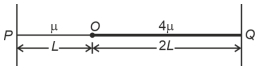
- 5Two uniform strings of mass per unit length $\mu$ and $4 \mu$, and length $L$ and $2 L$, respectively, are joined at point $O$, and tied at two fixed ends $P$ and $Q$, as shown in the figure. The strings are under a uniform tension $T$. If we define the frequency $v_0=\frac{1}{2 L} \sqrt{\frac{T}{\mu}}$, which of the following statement($s$) is(are) correct?View Solution
$(A)$ With a node at $O$, the minimum frequency of vibration of the composite string is $v_0$
$(B)$ With an antinode at $O$, the minimum frequency of vibration of the composite string is $2 v_0$
$(C)$ When the composite string vibrates at the minimum frequency with a node at $O$, it has $6$ nodes, including the end nodes
$(D)$ No vibrational mode with an antinode at $O$ is possible for the composite string
- 6View SolutionSound travels in rocks in the form of
- 7When a tuning fork $A$ of unknown frequency is sounded with another tuning fork $B$ of frequency $256 Hz$, then $3$ beats per second are observed. After that $A$ is loaded with wax and sounded, the again $3$ beats per second are observed. The frequency of the tuning fork $A$ is ..... $Hz$View Solution
- 8A siren placed at a railway platform is emitting sound of frequency $5 kHz$. A passenger sitting in a moving train $A$ records a frequency of $5.5 kHz$ while the train approaches the siren. During his return journey in a different train $B$ he records a frequency of $6.0 kHz$ while approaching the same siren. The ratio of the velocity of train $B$ to that of train $A$ isView Solution
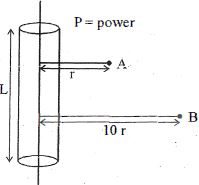
- 9There is a long linear source of sound whose power is $P$ and length is $L$. At point$A$, sound level is $80$ $dB$ .Then at point $B$ sound level will be .... $dB$View Solution
- 10The equation of a progressive wave is $y = a\,\sin \,\left( {\frac{\pi }{2}x - 200\pi t} \right)$ . The frequency of the wave will be .... $Hz$View Solution