If $n,\,e,\,\tau $ and $m$ respectively represent the density, charge relaxation time and mass of the electron, then the resistance of a wire of length $l$ and area of cross-section $A$ will be
Easy


Download our appand get started for free
Experience the future of education. Simply download our apps or reach out to us for more information. Let's shape the future of learning together!No signup needed.*
Similar Questions
- 1A ($100\, W$, $200\, V$) bulb is connected to a $160\, V$ power supply. The power consumption would be ............. $W$View Solution
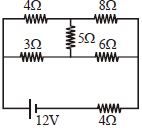
- 2In the given figure the ratio of current in $8\,\Omega $ and $3\,\Omega $ will beView Solution
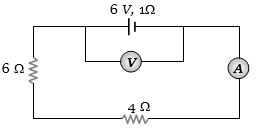
- 3View SolutionIn the circuit shown here, the readings of the ammeter and voltmeter are
- 4$n$ equal resistors are first connected in series and then connected in parallel. What is the ratio of the maximum to the minimum resistanceView Solution
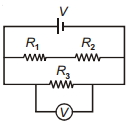
- 5In the circuit shown, $R_1$ is increased. What happens to the reading of the voltmeter (ideal)?View Solution
- 6View SolutionA heater coil is cut into two equal parts and only one part is now used in the heater. The heat generated will now be
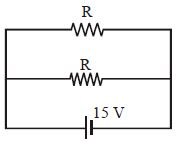
- 7If power dissipated in the circuit is $150\,W,$ then value of $R$ is ............... $\Omega$View Solution
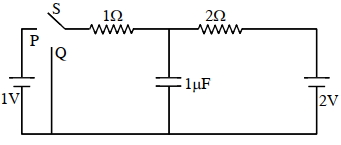
- 8In the circuit shown below, the switch $S$ is connected to position $P$ for a long time so that the charge on the capacitor becomes $q _1 \mu C$. Then $S$ is switched to position $Q$. After a long time, the charge on the capacitor is $q _2 \mu C$.View Solution
($1$) The magnitude of $q_1$ is
($2$) The magnitude of $q _2$ is
Give the answer of question ($1$) and ($2$)
- 9View SolutionAssertion : Ohm's law is applicable for all conducting elements.
Reason : Ohm's law is a fundamental law
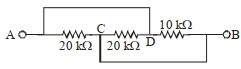
- 10The equivalent resistance between $A$ and $B$ as shown in figure is $........\,k\Omega$View Solution