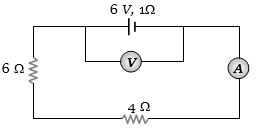
In the circuit shown here, the readings of the ammeter and voltmeter are
Medium
Download our app for free and get started
The given circuit can be redrawn as follows
Current $i = \frac{6}{{6 + 4 + 1}} = \frac{6}{{11}}A$
P.D. between $A$ and $B$, $V = \frac{6}{{11}} \times 10 = \frac{{60}}{{11}}V$.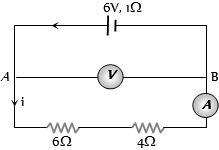

Download our appand get started for free
Experience the future of education. Simply download our apps or reach out to us for more information. Let's shape the future of learning together!No signup needed.*
Similar Questions
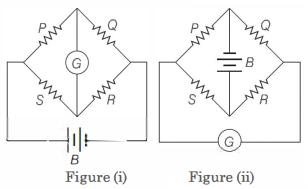
- 1Figure $(i)$ below shows a Wheatstone's bridge in which $P, Q, R$ and $S$ are fixed resistances, $G$ is a galvanometer and $B$ is a battery. For this particular case, the galvanometer shows zero deflection. Now, only the positions of $B$ and $G$ are interchanged, as shown in figure $(ii)$. The new deflection of the galvanometerView Solution
- 2View SolutionThe equivalent resistance of the infinite network given below is :
- 3View SolutionThe following four wires are made of the same material and are at the same temperature. Which one of them has highest electrical resistance
- 4The electromotive force of a primary cell is $2\, volts$. When it is short-circuited it gives a current of $4$ amperes. Its internal resistance in $ohms$ isView Solution
- 5Two resistors of resistance, $100\,\Omega$ and $200\,\Omega$ are connected in parallel in an electrical circuit. The ratio of the thermal energy developed in $100\,\Omega$ to that in $200\,\Omega$ in a given time is:View Solution
- 6$12$ cells each having same $emf$ are connected in series with some cells wrongly connected. The arrangement is connected in series with an ammeter and two cells which are in series. Current is $3 \,A$ when cells and battery aid each other and is $2\, A$ when cells and battery oppose each other. The number of cells wrongly connected isView Solution
- 7Two resistors are connected $(a)$ in series $(b)$ in parallel. The equivalent resistance in the two cases are $9$ $ohm$ and $2$ $ohm$ respectively. Then the resistances of the component resistors areView Solution
- 8Two resistors $400\, \Omega$ and $800\, \Omega$ are connected in series across a $6 V$ battery. The potential difference measured by a voltmeter of $10\, k \Omega$ across $400\, \Omega$ resistor is close to$....V$View Solution
- 9In the figure given below, the current passing through $6\,\Omega $ resistor is ........... $ampere$View Solution
- 10View SolutionSee the electrical circuit shown in the adjoining figure. Which of the following equation is a correct equation for it