MCQ
If no external voltage is applied across P-N junction, there would be
  • A
    No electric field across the junction
  •  An electric field pointing from N-type to P-type side across the junction
  • C
    An electric field pointing from P-type to N-type side across the junction
  • D
    A temporary electric field during formation of P-N junction that would subsequently disappear
Answer

Correct option: B.
 An electric field pointing from N-type to P-type side across the junction
An electric field pointing from N-type to P-type side across the junction

Need a full question paper?

Generate a complete, print-ready paper with questions like this in minutes — across 16+ boards, with answer keys.

Start Generating Free

Similar questions

The self produced $emf$ of a coil is $25\,volts$. When the current in it is changed at uniform rate from $10\,A$ to $25\, A$ in $1\,s$, the change in the energy of the inductance is......$J$
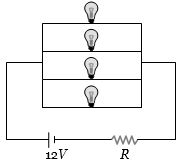
Four identical electrical lamps are labelled $1.5\,V$, $0.5\,A$ which describes the condition necessary for them to operate at normal brightness. A $12\,V$ battery of negligible internal resistance is connected to lamps as shown, then
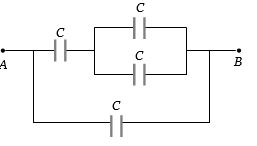
Four equal capacitors, each of capacity $C$, are arranged as shown. The effective capacitance between $A$ and $B$ is
A light emitting diode $(LED)$ is fabricated using GaAs semiconducting material whose band gap is $1.42 \mathrm{eV}$. The wavelength of light emitted from the $LED$ is:
Eddy currents are produced when
In a circuit, a metal filament lamp is connected in series with a capacitor of capacitance $C \mu F$ across a $200 V , 50 Hz$ supply. The power consumed by the lamp is $500 W$ while the voltage drop across it is $100 V$. Assume that there is no inductive load in the circuit. Take $m m s$ values of the voltages. The magnitude of the phase-angle (in degrees) between the current and the supply voltage is $\varphi$.

Assume, $\pi \sqrt{3} \approx 5$. . . . .

($1$) The value of $C$ is . . . . . .

($2$) The value of $\varphi$ is

Give the answers of the questions ($1$) and ($2$)

A toy car with charge $q$ moves on a frictionless horizontal plane surface under the influence of a uniform electric field $\vec E .$ Due to the force $q\vec E$ , its velocity increases from $0$ to $6\,\, m s^{-1}$ in one second duration. At that instant the direction of the field is reversed. The car continues to move for two more seconds under the influence of this field. The average velocity and tlie average speed of the toy car between $0$ to $3$ seconds are respectively 
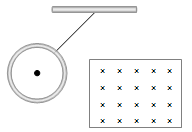
A metallic ring connected to a rod oscillates freely like a pendulum. If now a magnetic field is applied in horizontal direction so that the pendulum now swings through the field, the pendulum will
If two $+5D$ lenses are mounted at some distance apart, the equivalent power will always be negative if the distance is
A convex mirror has a radius of curvature of $22 \;cm$. If an object is placed $14 \;cm$ away from the mirror then its image is formed at