Question
If $^n{P_r} = 840,{\,^n}{C_r} = 35,$ then $n$ is equal to

Answer

d
(d) $\frac{{^n{P_r}}}{{^n{C_r}}} = 24 \Rightarrow r\;! = 24 \Rightarrow r = 4$

$\therefore $$^n{C_4} = 35 \Rightarrow n = 7$.

Need a full question paper?

Generate a complete, print-ready paper with questions like this in minutes — across 16+ boards, with answer keys.
Start Generating Free

Similar questions

The inradius of $\Delta  ABC$ is $3$ units and exradius opposite to vertex $A$ is $4$ units, then length of altitude from vertex $A$ is - ............. $\mathrm{units}$
If the roots of the given equation $2{x^2} + 3(\lambda - 2)x + \lambda + 4 = 0$ be equal in magnitude but opposite in sign, then $\lambda $=
The sum of the $3^{rd}$ and the $4^{th}$ terms of a $G.P.$ is $60$ and the product of its first three terms is $1000$. If the first term of this $G.P.$ is positive, then its $7^{th}$ term is
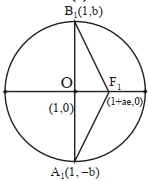
Let an ellipse with centre $(1,0)$ and latus rectum of length $\frac{1}{2}$ have its major axis along $x$-axis. If its minor axis subtends an angle $60^{\circ}$ at the foci, then the square of the sum of the lengths of its minor and major axes is equal to $...........$.
A particle moves along the curve $y = x^{3/2}$ in the first quadrant in such a way that its distance from the origin increases at the rate of $11$ units per second. The value of $\frac{{dx}}{{dt}}$ when $x = 3$ is
Let $A=\{1,2,3,4\}$ and $R$ be a relation on the set $A \times A$ defined by $R=\{((a, b),(c, d)): 2 a+3 b=4 c+5 d\}$. Then the number of elements in $R$ is:
How many numbers, lying between $99$ and $1000$ be made from the digits $2, 3, 7, 0, 8, 6$ when the digits occur only once in each number
Minimum number of times a fair coin must be tossed so that the probability of getting at least one head is more than $99\%$ is
A parabola passing through the point $( - 4,\; - 2)$ has its vertex at the origin and $y$ - axis as its axis. The latus rectum of the parabola is
If $\alpha ,\,\beta ,\,\gamma $ and $\delta $ are the solutions of the equation $\tan \left( {\theta  + \frac{\pi }{4}} \right) = 3\,\tan \,3\theta $ , no two of which have equal tangents, then the value of $tan\, \alpha  + tan\, \beta + tan\, \gamma + tan\, \delta $ is