MCQ
If $\oint_s \vec{E} \cdot \overrightarrow{d S}=0$ over a surface, then:
  • A
    the electric field inside the surface is necessarily uniform.
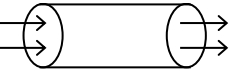
  • the number of flux lines entering the surface must be equal to the number of flux lines leaving it.
  • C
    the magnitude of electric field on the surface is constant.
  • D
    all the charges must necessarily be inside the surface.
Answer

Correct option: B.
the number of flux lines entering the surface must be equal to the number of flux lines leaving it.
b
$\phi_{\text {closed }}=0$

$\text { So } \phi_{\text {in }}=\phi_{\text {out }}$

Number of field lines entering is equal number of field lines leaving.

Need a full question paper?

Generate a complete, print-ready paper with questions like this in minutes — across 16+ boards, with answer keys.

Start Generating Free

Similar questions

Two different loops are concentric and lie in the same plane. The current in the outer loop is clockwise and increasing with time. The induced current in the inner loop then, is
An example of a diamagnetic substance is
The electrostatic potential inside a charged spherical ball is given by $\phi= a{r^2} + b$ where $r$ is the distance from the centre and $a, b$ are constants. Then the charge density inside the ball is:
A compass needle is placed in the gap of a parallel plate capacitor. The capacitor is connected to a battery through a resistance. The compass needle:
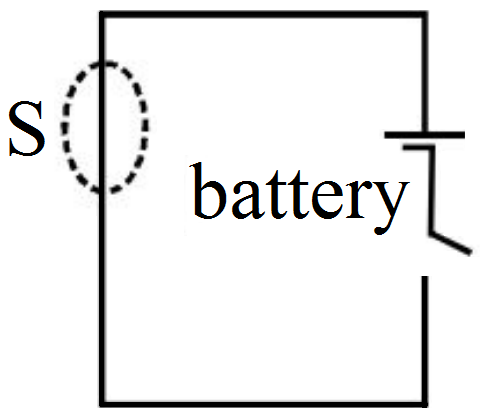
A closed surface S is constructed around a conducting wire connected to a battery and a switch (figure). As the switch is closed, the free electrons in the wire start moving along the wire. In any time interval, the number of electrons entering the closed surface S is equal to the number of electrons leaving it. On closing the switch, the flux of the electric field through the closed surface:
Sodium has body centred packing. If the distance between two nearest atoms is 3.7 Å, then its lattice parameter is
A positively charged pendulum is oscillating in a uniform electric field pointing upwards. Its time period as compared to that when it oscillates without electric field
The work done in turning a magnet of magnetic moment $ 'M'$  by an angle of $ 90°$  from the meridian is $'n' $ times the corresponding work done to turn it through an angle of $60°$, where $ 'n'$  is given by
$A$ thin wire of length $2m$ is perpendicular to the $xy$ plane. It is moved with velocity $\vec v = (2\hat i + 3\hat j + \hat k)\,m/s$ through $a$ region of magnetic induction $\vec B = (\hat i + 2\hat j)\,\,Wb/{m^2}$. Then potential difference induced between the ends of the wire :........$volts$
At a certain place the horizontal component of the earth’s magnetic field is $B_0$ and the angle of dip is $45^o$. The total intensity of the field at that place will be