MCQ
If $|\,\vec A + \vec B\,|\, = \,|\,\vec A\,| + |\,\vec B\,|$, then angle between $\vec A$ and $\vec B$ will be ....... $^o$
  • A
    $90$
  • B
    $120$
  • $0$
  • D
    $60$

Answer

Correct option: C.
$0$
c
(c) Resultant of two vectors $\overrightarrow A $ and $\overrightarrow B $ can be given by

$\overrightarrow R = \overrightarrow A + \overrightarrow B $

$|\overrightarrow R |\, = \,|\overrightarrow A + \overrightarrow B |\, = \sqrt {{A^2} + {B^2} + 2AB\cos \theta } $

If $\theta = 0^\circ $ then $|\overrightarrow R |\, = A + B$$ = \,|\overrightarrow A | + |\overrightarrow B |$

Need a full question paper?

Generate a complete, print-ready paper with questions like this in minutes — across 16+ boards, with answer keys.

Start Generating Free

Similar questions

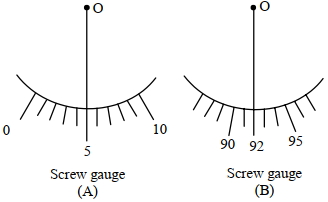
Student $A$ and Student $B$ used two screw gauges of equal pitch and $100$ equal circular divisions to measure the radius of a given wire. The actual value of the radius of the wire is $0.322\, {cm}$. The absolute value of the difference between the final circular scale readings observed by the students $A$ and $B$ is .... .

[Figure shows position of reference $'O'$ when jaws of screw gauge are closed]

Given pitch $=0.1 \,{cm}$.
A particle is moving along a straight line parallel to $x-$ axis with constant velocity. Its angular momentum about the origin
Out of the following which quantity does not depend on path
A body falls freely from rest. It covers as much distance in the last second of its motion as covered in the first three seconds. The body has fallen for a time of........$s$
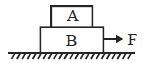
In figure, the coefficient of friction between the floor and the block $B$ is $0.1$. The coefficient of friction between the blocks $B$ and $A$ is $0.2$. The mass of $A$ is $\frac{m}{2}$  and of $B$ is $m$. ........ $mg$  is the maximum horizontal force $F$ can be applied to the block $B$ so that two blocks move together ?
For a moving coil galvanometer, the deflection in the coil is $0.05\,rad$ when a current of $10\,mA$ is passed through it. If the torsional constant of suspension wire is $4.0 \times 10^{-5}\,Nm\,rad ^{-1}$, the magnetic field is $0.01\,T$ and the number of turns in the coil is $200$,the area of each turn (in $cm ^2$ ) is :
A circular disc is rolling on a horizontal plane. Its total kinetic energy is  $300\,\,J.$  ......... $J$ is its translational  $K.E.$
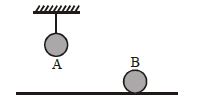
Two identical balls, $A$ and $B$ , of uniform composition and initially at the same temperature, each absorb exactly the same amount of heat. $A$ is hanging down from the ceiling while $B$ rests on the horizontal floor in the same room. Assuming no subsequent heat loss by the balls, which of the following statements is correct about their final temperatures, $T_A$ and $T_B$ , once the balls have reached their final state?
Two discs $A$ and $\mathrm{B}$ are mounted coaxially on a vertical axle. The discs have moments of inertia $I$ and $2 I$ respectively about the common axis. Disc $\mathrm{A}$ is imparted an initial angular velocity $2 \omega$ using the entire potential energy of a spring compressed by a distance $x_1$. Disc $B$ is imparted an angular velocity $\omega$ by a spring having the same spring constant and compressed by a distance $x_2$. Both the discs rotate in the clockwise direction.

$1.$  The ratio of $x_1 / x_2$ is

$(A)$ $2$  $(B)$ $\frac{1}{2}$  $(C)$ $\sqrt{2}$  $(D)$ $\frac{1}{\sqrt{2}}$

$2.$  When disc $\mathrm{B}$ is brought in contact with disc $\mathrm{A}$, they acquire a common angular velocity in time $\mathrm{t}$. The average frictional torque on one disc by the other during this period is

$(A)$ $\frac{2 \mathrm{I} \omega}{3 \mathrm{t}}$  $(B)$ $\frac{9 \mathrm{I} \omega}{2 \mathrm{t}}$  $(C)$ $\frac{9 \mathrm{I} \omega}{4 \mathrm{t}}$  $(D)$ $\frac{3 \mathrm{I} \omega}{2 \mathrm{t}}$

$3.$  The loss of kinetic energy during the above process is

$(A)$ $\frac{\mathrm{I} \omega^2}{2}$  $(B)$ $\frac{\mathrm{I} \omega^2}{3}$  $(C)$ $\frac{\mathrm{I} \omega^2}{4}$  $(D)$ $\frac{\mathrm{I} \omega^2}{6}$

Give the answer question $1,2$ and $3.$

A thick plane mirror shows a number of images of the filament of an electric bulb. Of these, the brightest image is the