If planned saving is less than planned investment, what changes will bring economy in equilibrium?
Download our app for free and get started
- In Keynesian theory, economy will be in equilibrium when planned saving[S] is equal to planned investment(I).
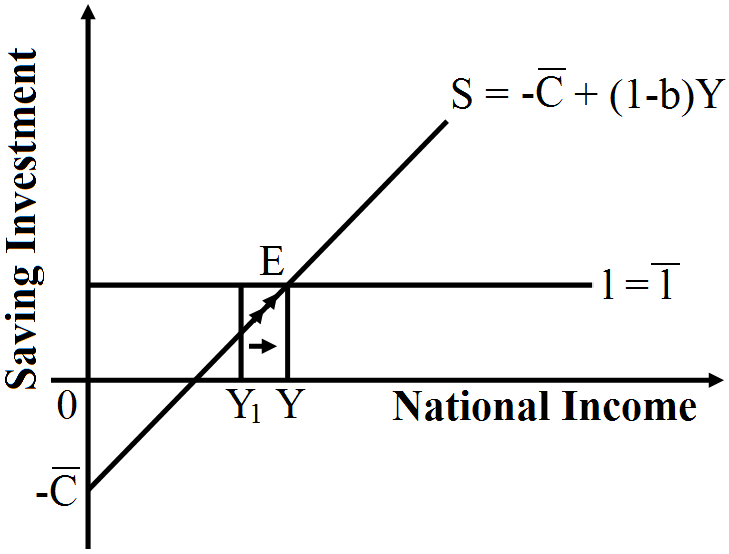
- In the above figure, the equilibrium level of national income is attained at point E, where saving = investment which is derived from a point where AD = AS.
C + I = C + S
I = S
- If, due to some disturbance, we divert from our position, like i. When planned saving is less than planned investment,
- At any lower level of output, say Y, in figure, planned saving is less than planned Investment.
- This means that households are consuming more than firms are expecting.
- This will lead to an unplanned, undesired decrease in inventories.
- Firms would then respond to this unplanned inventory decrease by increasing employment and hence output.
- This process of increase in output will continue until economy is back at point E, where planned saving = planned Investment.

Download our appand get started for free
Experience the future of education. Simply download our apps or reach out to us for more information. Let's shape the future of learning together!No signup needed.*
Similar Questions
- 1View SolutionThe break-even level of income for an economy is given to be ₹ 5000 crore. If the economy saves 50 percent of additional income, calculate the value of autonomous consumption.
- 2View SolutionWhat is investment multiplier? Explain its working using a suitable numerical example.
- 3View SolutionDifferentiate between APC and MPC.
- 4View SolutionWhat are two alternative ways of determining equilibrium level of income? How are these related?
- 5View SolutionIn an economy, an increase in investment leads to increase in national income which is three times more than the increase in investment. Calculate marginal propensity to consume.
- 6View SolutionAn economy is in equilibrium. From the following data, calculate the marginal propensity to save:
- Income = 10,000
- Autonomous consumption = 500
- Consumption expenditure = 8,000
- 7View SolutionGiving reasons, state whether the following statements are true or false:
- When marginal propensity to consume is zero, the value of investment multiplier will also be zero.
- Value of average propensity to save can never be less than zero.
- 8View SolutionThe savings function of an economy is S = -200 + 0.25Y. The economy is in equilibrium when income is equal to ₹ 2,000.
Calculate:- Investment expenditure at equilibrium level of income.
- Autonomous consumption.
- 9View SolutionTax rates on higher income group have been increased. Which economic value does it reflect? Explain.
- 10View SolutionWhat are impacts or effects of excess demand on price, output, employment?