If Poission's ratio $\sigma $ is $ - \frac{1}{2}$ for a material, then the material is
Easy


Download our appand get started for free
Experience the future of education. Simply download our apps or reach out to us for more information. Let's shape the future of learning together!No signup needed.*
Similar Questions
- 1View SolutionWhich of the following statements is correct
- 2The stress-strain curves are drawn for two different materials $X$ and $Y$. It is observed that the ultimate strength point and the fracture point are close to each other for material $X$ but are far apart for material $Y$. We can say that materials $X$ and $Y$ are likely to be (respectively)View Solution
- 3What is the percentage increase in length of a wire of diameter $2.5 \,mm$, stretched by a force of $100 \,kg$ wt is .................. $\%$ ( Young's modulus of elasticity of wire $=12.5 \times 10^{11} \,dyne / cm ^2$ )View Solution
- 4A wire of diameter $1mm$ breaks under a tension of $1000\, N.$ Another wire, of same material as that of the first one, but of diameter $2\, mm$ breaks under a tension of ...... $N$View Solution
- 5A composite rod made up of two rods $AB$ and $BC$ are joined at $B$ . The rods are of equal length at room temperature and have equal masses. The coefficient of linear expansion a of $AB$ is more than that of $BC$. The composite rod is suspended horizontal by means of a thread at $B$. When the rod is heatedView Solution
- 6View SolutionFour identical rods are stretched by same force. Maximum extension is produced in
- 7View SolutionIf the density of the material increases, the value of Young's modulus
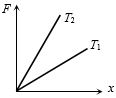
- 8The diagram shows the change $x$ in the length of a thin uniform wire caused by the application of stress $F$ at two different temperatures $T_1$ and $T_2$. The variations shown suggest thatView Solution
- 9View SolutionYoung's modulus depends upon
- 10In steel, the Young's modulus and the strain at the breaking point are $2 \times {10^{11}}\,N{m^{ - 2}}$ and $0.15$ respectively. The stress at the breaking point for steel is thereforeView Solution