MCQ
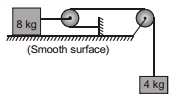
If pulleys shown in the diagram are smooth and massless and $a_1$ and $a_2$ are acceleration of blocks of mass $4 \,kg$ and $8 \,kg$ respectively, then
  • A
    $a_1=a_2$
  • $a_1=2 a_2$
  • C
    $2 a_1=a_2$
  • D
    $a_1=4 a_2$

Answer

Correct option: B.
$a_1=2 a_2$
b
(b)

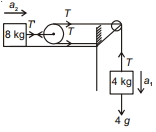
For $8 kg T^{\prime}=8 a_1 \ldots(i)$

for $4 kg$

$4 g-T=4 a_2 \ldots(ii)$

for pulley

$T^1=2 T \ldots(iii)$

Using $(i), (ii)$ and $(iii)$

$a_2=\frac{a_1}{2}$
Need a full question paper?

Generate a complete, print-ready paper with questions like this in minutes — across 16+ boards, with answer keys.

Start Generating Free

Similar questions

$1\,eV$ is
A ball is dropped from the top of a building $100\,m$ high. At the same instant another ball is thrown upwards with a velocity of $40\,m / s$ from the bottom of the building. The two balls will meet after $..........\,s$
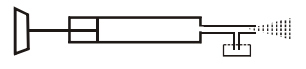
A spray gun is shown in the figure where a piston pushes air out of a nozzle. A thin tube of uniform cross section is connected to the nozzle. The other end of the tube is in a small liquid container. As the piston pushes air through the nozzle, the liquid from the container rises into the nozzle and is sprayed out. For the spray gun shown, the radii of the piston and the nozzle are $20 \ mm$ and $1 \ mm$ respectively. The upper end of the container is open to the atmosphere. $Image$

$1.$ If the piston is pushed at a speed of $5 \ mms ^{-1}$, the air comes out of the nozzle with a speed of

$(A)$ $0.1 \ ms ^{-1}$ $(B)$ $1 \ ms ^{-1}$ $(C)$ $2 \ ms ^{-1}$ $(D)$ $8 \ ms ^{-1}$

$2.$ If the density of air is $\rho_{ a }$ and that of the liquid $\rho_{\ell}$, then for a given piston speed the rate (volume per unit time) at which the liquid is sprayed will be proportional to

$(A)$ $\sqrt{\frac{\rho_{ a }}{\rho_{\ell}}}$ $(B)$ $\sqrt{\rho_a \rho_{\ell}}$ $(C)$ $\sqrt{\frac{\rho_{\ell}}{\rho_{ a }}}$ $(D)$ $\rho_{\ell}$

Give the answer question $1$ and $2.$
In a diatomic molecule, the rotational energy at a given temperature.
  1. Obeys Maxwell’s distribution.
  2. Have the same value for all molecules.
  3. Equals the translational kinetic energy for each molecule.
  4. Is $(2/3)^{rd}$ the translational kinetic energy for each molecule.
An expression for a dimensionless quantity $P$ is given by $P=\frac{\alpha}{\beta} \log _{e}\left(\frac{ kt }{\beta x }\right)$; where $\alpha$ and $\beta$ are constants, $x$ is distance ; $k$ is Boltzmann constant and $t$ is the temperature. Then the dimensions of $\alpha$ will be
Inertia is that property of a body by virtue of which the body is
$A$ particle is released from rest at origin. It moves under influence of potential field $U = x^2 - 3x$ , kinetic energy at $x = 2$ is ............... $\mathrm{J}$
A car is moving in a circular horizontal track of radius $10\, m$ with a constant speed of $10 \,m/sec$. A plumb bob is suspended from the roof of the car by a light rigid rod of length $1.00\, m$. The angle made by the rod with track is ........ $^o$
The acceleration due to gravity on the surface of the moon is $1.7\ ms^{-2}$. The time period of a simple pendulum on the moon, if its time period on the earth is $3.5s$ is:
The potential energy of a body is given by, $U =A - B{x^2}$(Where x is the displacement). The magnitude of force acting on the particle is