MCQ
A ball is dropped from the top of a building $100\,m$ high. At the same instant another ball is thrown upwards with a velocity of $40\,m / s$ from the bottom of the building. The two balls will meet after $..........\,s$
  • A
    $3$
  • B
    $2$
  • $2.5$
  • D
    $5$

Answer

Correct option: C.
$2.5$
c
(c)

Let balls meet after $t s$. The distance travelled by the ball coming down is

$s_1=\frac{1}{2} g t^2$

Distance travelled by the other ball

$s_2=40 t-\frac{1}{2} g t^2$

$\because \quad s_1+s_2=100\,m$

$\therefore \quad \frac{1}{2} g t^2+40 t-\frac{1}{2}\,g t^2=100\,m$

$t=\frac{100}{40}=2.5\,s$

Need a full question paper?

Generate a complete, print-ready paper with questions like this in minutes — across 16+ boards, with answer keys.

Start Generating Free

Similar questions

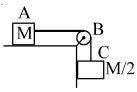
A block of mass $M$ on a horizontal smooth surface is pulled by a load of mass $M/2$ by means of a rope $AB$ and string $BC$ as shown in the figure. The length & mass of the rope $AB$ are $L$ and $M/2$ respectively. As the block is pulled from $AB = L$ to $AB = 0$ its acceleration changes from $3g$
A body $A$ of mass $\mathrm{m}$ is moving in a circular orbit of radius $\mathrm{R}$ about a planet. Another body $\mathrm{B}$ of mass $\frac{\mathrm{m}}{2}$ collides with $\mathrm{A}$ with a velocity which is half $\left(\frac{\overrightarrow{\mathrm{v}}}{2}\right)$ the instantaneous velocity $\overrightarrow{\mathrm{v}}$ of $\mathrm{A}$ The collision is completely inelastic. Then, the combined body
For a projectile, the ratio of maximum height reached to the square of flight time is ($g = 10 ms^{-2}$)
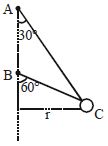
A single wire $ACB$ passes through a smooth ring at $C$ which revolves at a constant speed in the horizontal circle of radius $r$ as shown in the figure. The speed of revolution is
The correct value of ${0^o}C$ on the Kelvin scale is ........... $K$
The force $F$ is given in terms of time $t$ and displacement $x$ by the equation $F = A\,cos\,Bx + C\,sin\,Dt.$ The dimensional formulae of $D/B$ is
A particle is subjected to two mutually perpendicular simple harmonic motions such that its $x$ and $y$ coordinates are given by ?

$ x = 2 \sin \omega t \,;$  $ y = 2 \sin  \left( {\omega t + \frac{\pi }{4}} \right)$

The path of the particle will be :

A wire of density $9 \times 10^{-3} \,kg\, cm ^{-3}$ is stretched between two clamps $1\, m$ apart. The resulting strain in the wire is $4.9 \times 10^{-4}$. The lowest frequency of the transverse vibrations in the wire is......$HZ$

(Young's modulus of wire $Y =9 \times 10^{10}\, Nm ^{-2}$ ), (to the nearest integer),

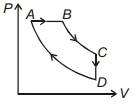
For $P-V$ diagram of a thermodynamic cycle as shown in figure, process $B C$ and $D A$ are isothermal. Which of the corresponding graphs is correct?
The value of $(\overrightarrow A + \overrightarrow B )\, \times (\overrightarrow A - \overrightarrow B )$ is