Question
If R be the horizontal range for inclination $\theta$ and h be the maximum height reached by the projectile, show that maximum range is given by $\frac{\text{R}^2}{8\text{h}}+2\text{h.}$

Answer

Horizontal range of the projectile is, $\text{R}=\frac{\text{u}^2\sin2\theta}{\text{g}}$ Maximum height attained by the projectile is,$\text{h}=\frac{\text{u}^2\sin^2\theta}{2\text{g}}$
$\therefore\ \frac{\text{R}^2}{8\text{h}}+2\text{h}$
$=\frac{\text{u}^2(\sin2\theta)^2}{\text{g}^2}\times\frac{2\text{g}}{8\text{u}^2\sin^2\theta}+\frac{2\text{u}^2\sin^2\theta}{2\text{g}}$
$=\frac{\text{u}^2(2\sin\theta\cos\theta)^2}{4\text{g}\sin^2\theta}+\frac{\text{u}^2\sin^2\theta}{\text{g}}$
$=\frac{\text{u}^2\cos^2\theta}{\text{g}}+\frac{\text{u}^2\sin^2\theta}{\text{g}}$
$=\frac{\text{u}^2}{\text{g}}(\cos^2\theta+\sin^2\theta)=\frac{\text{u}^2}{\text{g}}=\text{R}_\text{max}$

Need a full question paper?

Generate a complete, print-ready paper with questions like this in minutes — across 16+ boards, with answer keys.
Start Generating Free

Similar questions

An electric heater supplies heat to a system at a rate of 100W. If system performs work at a rate of 75 joules per second. At what rate is the internal energy increasing?
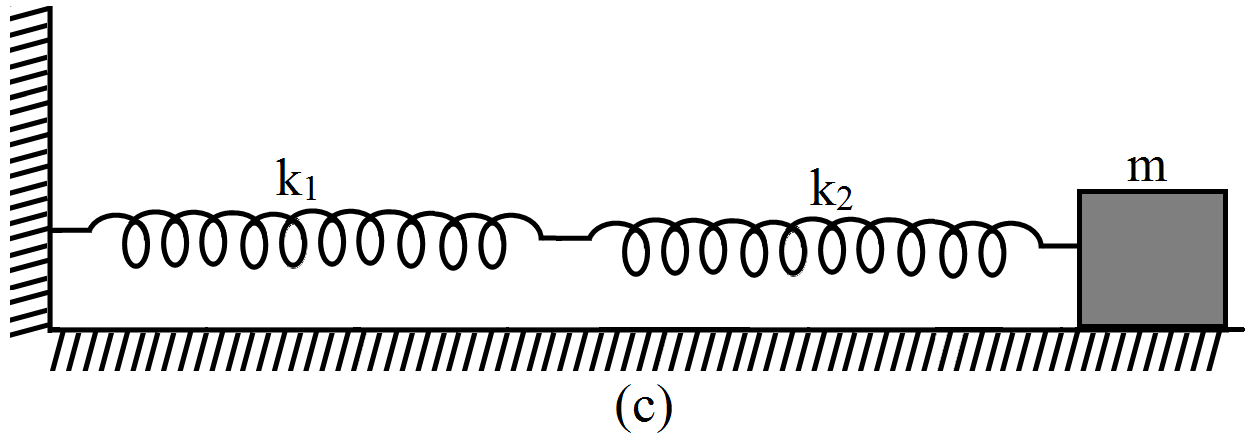
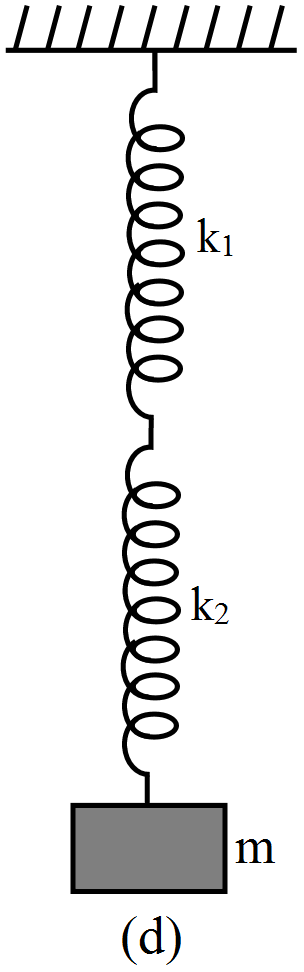
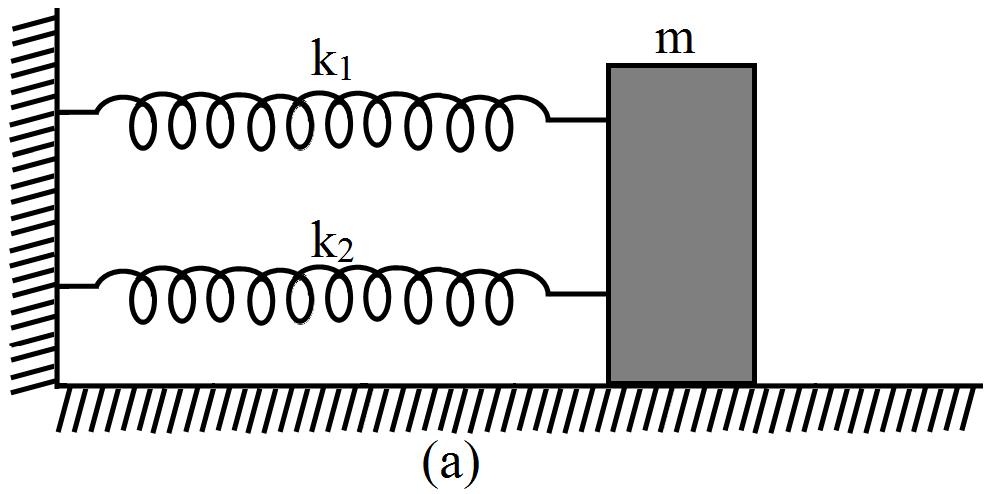
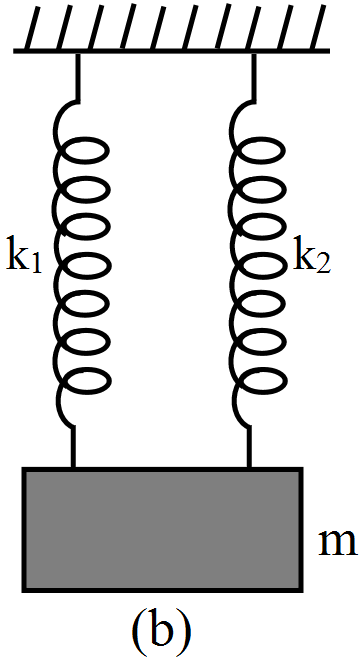
Figure below shows four different spring arrangements. If the mass in each arrangement is displaced from its equilibrium position and released, what is the resulting frequency of vibration in each case? Neglect the mass of the spring. (Fig. (a) and (b) represent an arrangement of springs in parallel, and (c) and (d) represent springs in series)


A ball is projected vertically upward with a speed of $50m/s$. Find:
  1. The maximum height.
  2. The time to reach the maximum height.
  3. The speed at half the maximum height. Take $g = 10m/s^2$.
A planet moves around the sun in a circular orbit. The time period of revolution $T$ of the planet depends on
  1. Radius of the orbit $(R)$.
  2. Mass of the sun $M$.
  3. Gravitational constant $G$.
Show dimensionally that $\text{T}^2\propto\text{R}^3$
If $\vec{\text{A}},\vec{\text{B}},\vec{\text{C}}$ are mutually perpendicular, show that $\vec{\text{C}}\times(\vec{\text{A}}\times\vec{\text{B}})=0.$ Is the converse true?
Consider the situation of the previous problem. Suppose the production of the radioactive isotope starts at t = 0. Find the number of active nuclei at time t.
Two trains A and B of length 400m each are moving on two parallel tracks with a uniform speed of $72km/ h^{-1}$ in the same direction, with A ahead of B. The driver of B desires to overtake A and accelerates by $1ms^{-2}​​​​​​​$. If, after 50s, the guard of B just brushes past driver of A, calculate the original distance between the two trains.
A rocket is fired from the earth towards the sun. At what distance from the earth's centre is the gravitational force on the rocket zero? Mass of the sun $=2 \times 10^{30} \mathrm{~kg}$, mass of the earth $=6 \times 10^{24} \mathrm{~kg}$. Neglect the effect of other planets etc. (orbital radius $=1.5 \times 10^{11} \mathrm{~m}$ ).
Let AE denote the energy gap between the valence band and the conduction band. The population of conduction electrons (and of the holes) is roughly proportional to $\text{e}^{\frac{-\Delta\text{E}}{2\text{kT}}}.$ Find the ratio of the concentration of condu.ction electrons in diamond to that in silicon at room temperature 300K. $\Delta\text{E}$ for silicon is 1.1eV and for diamond is 6.0eV. How many conduction electrons are likely to be in one cubic metre of diamond?