Question
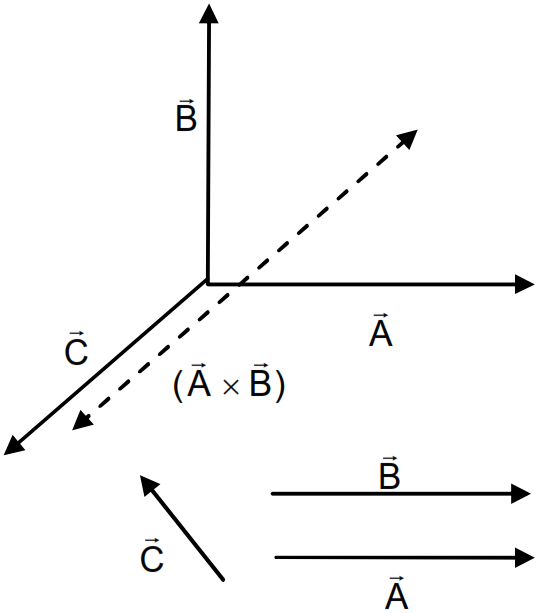
If $\vec{\text{A}},\vec{\text{B}},\vec{\text{C}}$ are mutually perpendicular, show that $\vec{\text{C}}\times(\vec{\text{A}}\times\vec{\text{B}})=0.$ Is the converse true?
Answer

Given that $\vec{\text{A}},\vec{\text{B}}$ and $\vec{\text{C}}$ are mutually perpendicular$\vec{\text{A}}\times\vec{\text{B}}$ is a vector which direction is perpendicular to the plane containing $\vec{\text{A}}$ and $\vec{\text{B}}.$ Also $\vec{\text{C}}$ is perpendicular to $\vec{\text{A}}$ and $\vec{\text{B}}$$\therefore$ Angle between $\vec{\text{C}}$ and $\vec{\text{A}}\times\vec{\text{B}}$ is $0^{\circ}$ or $180^{\circ}$
So, $\vec{\text{C}}\times(\vec{\text{A}}\times\vec{\text{B}})=0$ The converse is not true. For example, if two of the vector are parallel, then also$\vec{\text{C}}\times(\vec{\text{A}}\times\vec{\text{B}})=0$
So, they need not be mutually perpendicular.

Need a full question paper?

Generate a complete, print-ready paper with questions like this in minutes — across 16+ boards, with answer keys.
Start Generating Free

Similar questions

A capacitor of capacitance $100\mu\text{F}$ is connected to a battery of 20 volts for a long time and then disconnected from it. It is now connected across a long solenoid having 4000 turns per metre. It is found that the potential difference across the capacitor drops to 90% of its maximum value in 2.0 seconds. Estimate the average magnetic field produced at the centre of the solenofd during this period.
A sound wave travelling along a string is described by $\text{y}(\text{x, t})=5\times10^{-3}\sin(80\text{x}-3\text{t})$ in which numerical constants are in $S.I$. unit. Calculate.
  1. The amplitude.
  2. The wave length.
  3. The period and frequency of the wave.
The velocity$-$time graph of an object moving along a straight line is as shown. Calculate distance covered by object between:

  1. $t = 0$ to $t = 5 sec.$
  2. $t = 0$ to $t = 10 sec.$
  1. What is the scale factor of human relative to monkey in relation to heartbeats?
  2. What is the monkey's heart rate?
Equal torqueses are applied on a cylinder and a sphere. Both have same mass and radius. The cylinder rotates about its axis and the sphere rotates about one of its diameters. Which will acquire greater speed? Explain why.
Find the angle of minimum deviation for an equilateral prism made of a material of refractive index 1.732. What is the angle of incidence for this deviation?
Two identical springs of spring constant k each are attached to a block of mass m as shown in figure:

Show that when the mass is displaced from its equilibrium position on either side, it executes a simple harmonic motion. Find the period of oscillations.
A physical quantity P is related to four observables a, b, c and d as follows: $\text{P}=\text{a}^3\text{b}^3/\big(\sqrt{\text{c}}\text{ d}\big)$ The percentage errors of measurement in a, b, c and d are 1%, 3%, 4% and 2%, respectively. What is the percentage error in the quantity P ? If the value of P calculated using the above relation turns out to be 3.763, to what value should you round off the result ?
The diameter of the sun is $1.4 \times 10^9m$ and its distance from the earth is $1.5 \times 10^{11}m$. Find the radius of the image of the sun formed by a lens of focal length $20cm$.
Solve the previous problem if the paperweight is inverted at its place so that the spherical surface touches the paper.