If resistance of the filament increases with temperature, what will be power dissipated in a $220\, V- 100\, W$ lamp when connected to $110\, V$ power supply
Easy
Download our app for free and get started
If resistance does not vary with temperature $P_{consumed} = $${\left( {\frac{{{V_A}}}{{{V_R}}}} \right)^2} \times {P_R} = {\left( {\frac{{110}}{{220}}} \right)^2} \times 100 = 25\,W$. But in second cases resistance decreases so consumed power will be more than $25\, W$

Download our appand get started for free
Experience the future of education. Simply download our apps or reach out to us for more information. Let's shape the future of learning together!No signup needed.*
Similar Questions
- 1A potentiometer circuit has been set up for finding the internal resistance of a given cell. The main battery, used across the potentiometer wire, has an emf of $2.0\,V$ and a negligible internal resistance. The potentiometer wire itself is $4\,m$ long. When the resistance $R,$ connected across the given cell, has values of $(i)$ infinity $(ii)$ $9.5\,\Omega$ the balancing lengths on the potentiometer wire are found to be $3\,m$ and $2.85\,m,$ respectively. The value of internal resistance of the cell is ............... $\Omega$View Solution
- 2The number of electrons flowing per second in the filament of a $110 \mathrm{~W}$ bulb operating at $220 \mathrm{~V}$ is : (Given $\mathrm{e}=1.6 \times 10^{-19} \mathrm{C}$ )View Solution
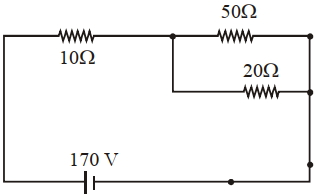
- 3The voltage across the $10\, \Omega$ resistor in the given circuit is $x$ volt.View Solution
The value of $'x'$ to the nearest integer is..........
- 4Heater of electric kettle is made of a wire of length $L$ and diameter $d$. It takes $4$ minutes to raise the temperature of $0.5 \ kg$ water by $40\ K$. This heater is replaced by a new heater having two wires of the same material, each of length $L$ and diameter $2 d$. The way these wires are connected is given in the options. How much time in minutes will it take to raise the temperature of the same amount of water by $40K$ ?View Solution
$(A)$ $4$ if wires are in parallel
$(B)$ $2$ if wires are in series
$(C)$ $1$ if wires are in series
$(D)$ $0.5$ if wires are in parallel.
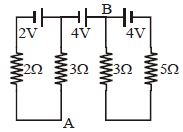
- 5In the given circuit calculate potential difference between $A$ and $B$ ............... $\mathrm{V}$View Solution
- 6A potentiometer having the potential gradient of $2\, mV/cm$ is used to measure the difference of potential across a resistance of $10 \,\Omega$. If a length of $50\, cm$ of the potentiometer wire is required to get the null point, the current passing through the $10 \,\Omega$ resistor is (in $mA$)View Solution
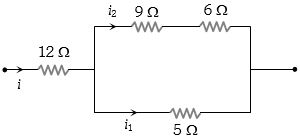
- 7In the following circuit, $5$ $\Omega$ resistor develops $45$ $J/s$ due to current flowing through it. The power developed per second across $12$ $\Omega$ resistor is ............. $W$View Solution
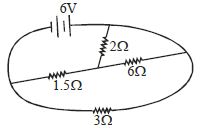
- 8Find the value of current from battery in the circuit ............... $A$View Solution
- 9There are two electric bulbs of $40\, W$ and $100\, W$. Which one will be brighter when first connected in series and then in parallel,View Solution
- 10A potentiometer circuit has been set up for finding the internal resistance of a given cell. The main battery, used across the potentiometer wire, has an emf of $2.0\,V$ and a negligible internal resistance. The potentiometer wire itself is $4\,m$ long. When the resistance $R,$ connected across the given cell, has values of $(i)$ infinity $(ii)$ $9.5\,\Omega$ the balancing lengths on the potentiometer wire are found to be $3\,m$ and $2.85\,m,$ respectively. The value of internal resistance of the cell is ............... $\Omega$View Solution