The number of electrons flowing per second in the filament of a $110 \mathrm{~W}$ bulb operating at $220 \mathrm{~V}$ is : (Given $\mathrm{e}=1.6 \times 10^{-19} \mathrm{C}$ )
JEE MAIN 2024, Diffcult
Download our app for free and get started
$\text { Power }(P)=V . I$
$\Rightarrow 110=(220)(I)$
$\Rightarrow I=0.5 \mathrm{~A}$
$\text { Now, } I=\frac{\mathrm{n} \cdot \mathrm{e}}{\mathrm{t}}$
$\Rightarrow 0.5=\left(\frac{\mathrm{n}}{\mathrm{t}}\right)\left(1.6 \times 10^{-19}\right)$
$\Rightarrow \frac{\mathrm{n}}{\mathrm{t}}=\frac{0.5}{1.6 \times 10^{-19}}$
$\Rightarrow \frac{\mathrm{n}}{\mathrm{t}}=31.25 \times 10^{17}$

Download our appand get started for free
Experience the future of education. Simply download our apps or reach out to us for more information. Let's shape the future of learning together!No signup needed.*
Similar Questions
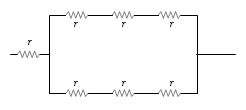
- 1View SolutionReferring to the figure below, the effective resistance of the network is
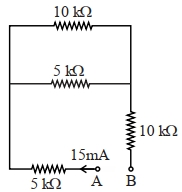
- 2A current of $15\,mA$ flows in the circuit as shown in figure. The value of potential difference between the points $A$ and $B$ will be $...\,V$View Solution
- 3The two ends of a uniform conductor are joined to a cell of $e.m.f.$ $E$ and some internal resistance. Starting from the midpoint $P$ of the conductor, we move in the direction of current and return to $P$. The potential $V$ at every point on the path is plotted against the distance covered $(x)$. Which of the following graphs best represents the resulting curveView Solution
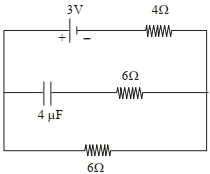
- 4In the network shown below, the charge accumulated in the capacitor in steady state will be ........... $\mu C$View Solution
- 5Given below are two statements:View Solution
Statement $I$ : A uniform wire of resistance $80\,\Omega$ is cut into four equal parts. These parts are now connected in parallel. The equivalent resistance of the combination will be $5\,\Omega$.
Statement $II :$ Two resistance $2\,R$ and $3\,R$ are connected in parallel in a electric circuit. The value of thermal energy developed in $3\,R$ and $2\,R$ will be in the ratio $3:2.$
In the light of the above statements, choose the most appropriate answer from the options given below
- 6The specific resistance of manganin is $50 \times {10^{ - 8}}\,ohm \times m$. The resistance of a cube of length $50\,cm$ will beView Solution
- 7View SolutionOhm's law fails in
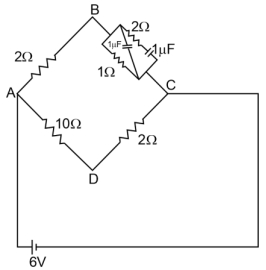
- 8For the given circuit, in the steady state, $\left| V _{ B }- V _{ D }\right|=.......V.$View Solution
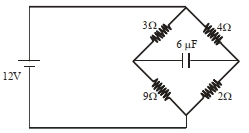
- 9In the circuit shown, the energy stored in the capacitor is $n\,\mu J$. The value of $n$ is ..............View Solution
- 10View SolutionA piece of wire is cut into four equal parts and the pieces are bundled together side by side to form a thicker wire. Compared with that of the original wire, the resistance of the bundle is ..........