Question
If $\sec\theta=\frac{17}{8},$ verify that $\frac{\big(3-4\sin^2\theta\big)}{\big(4\cos^2\theta-3\big)}=\frac{\big(3-\tan^2\theta\big)}{\big(1-3\tan^2\theta\big)}.$
Answer

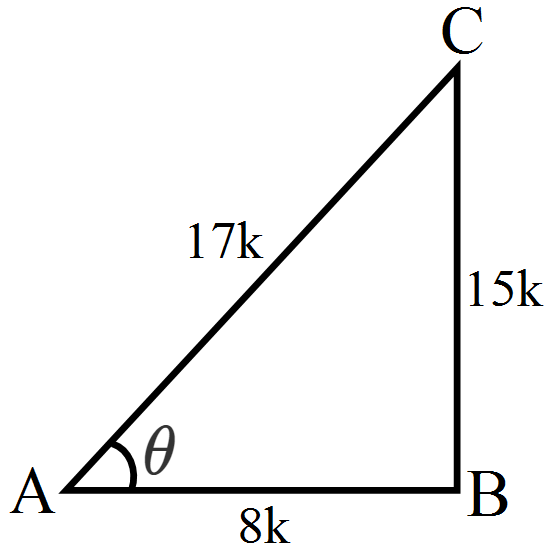
Given: $\sec\theta=\frac{17}{8}=\frac{17\text{k}}{8\text{k}}$ Let us draw a $\triangle\text{ABC},$ in which $\angle\text{B}=90^\circ$ and $\angle\text{A}=\theta$
By pythagoras theoram we have $\text{AC}^2 = \text{AB}^2 + \text{BC}^2$ Or $\text{BC}^2 = \text{AC}^2 + \text{AB}^2$ $\therefore\text{BC}^2=\big(17\text{k}\big)^2-\big(8\text{k}\big)^2$ $=289\text{k}^2-64\text{k}^2=225\text{k}^2$ $=\text{BC}=15\text{k}$ $\therefore\ \sin\theta=\frac{\text{AC}}{\text{BC}}=\frac{15{\text{k}}}{17\text{k}}=\frac{15}{17}$ $\cos\theta=\frac{\text{AB}}{\text{AC}}=\frac{8\text{k}}{17\text{k}}=\frac{8}{17}$ $\tan\theta=\frac{15\text{k}}{8\text{k}}=\frac{15}{8}$ $\text{L.H.S.}=\frac{3-4\sin^2\theta}{4\cos^2\theta-3}$ $=\frac{3-4\times\big(\frac{15}{17}\big)^2}{4\times\big(\frac{8}{17}\big)^2-3}$ $=\frac{3-\frac{4\times225}{289}}{4\times\frac{64}{289}-3}$ $=\frac{\frac{3\times289-4\times225}{289}}{\frac{4\times64-3\times289}{289}}$ $=\frac{867-900}{256-867}=\frac{-33}{-611}=\frac{33}{611}$ $\text{R.H.S.}=\frac{3-\tan^2\theta}{1-3\tan^2\theta}=\frac{3-\big(\frac{15}{8}\big)^2}{1-3\times\big(\frac{15}{8}\big)^2}$ $=\frac{3-\frac{225}{64}}{1-3\times\frac{225}{64}}=\frac{\frac{3\times64-225}{64}}{\frac{64-3\times225}{64}}$ $=\frac{192-225}{64-675}=\frac{-33}{-611}=\frac{33}{611}$ Hence, L.H.S = R.H.S.

Need a full question paper?

Generate a complete, print-ready paper with questions like this in minutes — across 16+ boards, with answer keys.

Start Generating Free

Similar questions

How many term are there in the AP $6, 10, 14, 18,....174?$
Thirty women were examined in a hospital by a doctor and the number of heart beats per minute recorded and summarised as follows. Find the mean heart beats per minute for these women, choosing a suitable method.
Number of heart beat per minute
65-68
68-71
71-74
74-77
77-80
80-83
83-86
Number of women
2
4
3
8
7
4
2
Find the mean of each of the following frequency distribution (5 - 14)
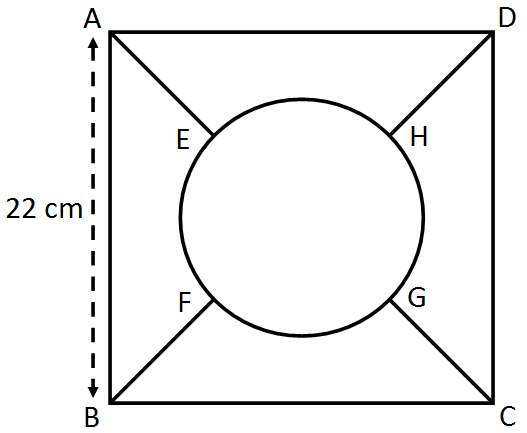
In the following figure, the square ABCD is divided into five equal parts, all having same area. The central part is circular and the lines AE, GC, BF and HD lie along the diagonals AC and BD of the square. If $AB = 22\ cm$, find:

The perimeter of the part ABEF.
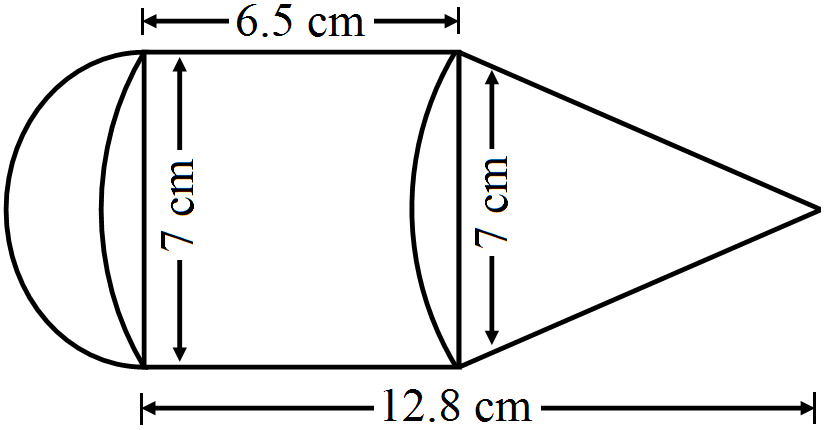
The given figure represents a solid consisting of a cylinder surmounted by a cone at one end and a hemisphere at the other. Find the volurne of the solid.
Determine whether the given points are collinear.
(1) A(0,2) , B(1,-0.5), C(2,-3)
(2) P(1, 2) , Q(2, 8/5) , R(3, 6/5)
(3) L(1,2) , M(5,3) , N(8,6)
If $\text{cosec}\theta=\sqrt{10},$ find the value of the all T-ratios of $\theta.$
In a circle of radius $7\ cm$, a square ABCD is inscribed. Find the area of the circle which is outside the square.
A game of chance consists of spinning an arrow, which comes to rest pointing at one of the number 1, 2, 3, 4, 5, 6, 7, 8 and these are equally likely outcomes. Find the probability that the arrow will point at any factor of 8.
State Pythagoras theorem and its converse.
If $a - b$, $a$ and $b$ are zeros of the polynomial $f(x) = 2x^3- 6x^2 + 5x - 7$, write the value of a.