MCQ
If $sin (xy) + cos (xy) = 0$ then $\frac{{dy}}{{dx}}=$
  • A
    $\frac{y}{x}$
  • $-\frac{y}{x}$
  • C
    $-\frac{x}{y}$
  • D
    $\frac{x}{y}$

Answer

Correct option: B.
$-\frac{y}{x}$
b
$\sin x y+\cos x y=0$

$\cos (x y)=-\sin x y$

diff. w.r.t. $x$

$-\sin x y\left[1 \cdot y+x \cdot \frac{d y}{d x}\right]=-\cos (x y)\left[1 \cdot y+x \cdot \frac{d y}{d x}\right]$

$y=\sin x+x \cdot \sin x y \cdot \frac{d y}{d x}=y \cdot \cos x y+x \cdot \cos x y \cdot \frac{d y}{d x}$

$(x \sin x y-x \cdot \cos x y) \frac{d y}{d x}=y \cos x y-y \sin x y$

$\frac{d y}{d x}=\frac{-y\left(\sin x y-\cos x y\right)}{x(\sin xy-\cos xy)}$

$\frac{d y}{d x}=-\frac{y}{x}$

Need a full question paper?

Generate a complete, print-ready paper with questions like this in minutes — across 16+ boards, with answer keys.
Start Generating Free

Similar questions

Two events A and B such that $P ( A )=\frac{1}{4}, P ( A \mid B )=\frac{1}{2}$, and $P(B \mid A)=\frac{2}{3}$, then value of $P(B)$ :
The matrix $\text{A}=\begin{bmatrix}0&-5&8\\5&0&12\\-8&-12&0\end{bmatrix}$ is a:
  1. Diagonal matrix.
  2. Symmetric matrix.
  3. Skew-symmetric matrix.
  4. Scalar matrix.
The value of $ \cos \left( \sin^{-1} \left( \frac {2}{3} \right) \right)$ is equal to :
  1. $ \frac {\sqrt4}{8}$
  2. $ \frac {\sqrt4}{3}$
  3. $ \frac {\sqrt5}{4}$
  4. $ \frac {\sqrt5}{3}$
If $f:IR \to IR$ is defined by $f(x) = 3x - 4$, then ${f^{ - 1}}:IR \to IR$ is
Set $A$ has three elements and set $B$ has four elements. The number of injections that can be defined from $A$ to $B$ is
$\mathop {\lim }\limits_{x \to \infty } \,\left( {\frac{n}{{{n^2}\, + {1^2}}} + \frac{n}{{{n^2} + {2^2}}} + \frac{n}{{{n^2} + {3^2}}} + ...\frac{1}{{5n}}} \right)$ is equal to
Two vectors $\vec{a}=a_1 \hat{i}+a_2 \hat{j}+a_3 \hat{k}$ and $\vec{b}=b_1 \hat{i}+b_2 \hat{j}+b_3 \hat{k}$ are collinear if
If $\sin^{-1}\Big(\frac{2\text{a}}{1-\text{a}^2}\Big)+\cos^{-1}\Big(\frac{1-\text{a}^2}{1+\text{a}^2}\Big)=\tan^{-1}\Big(\frac{2\text{x}}{1-\text{x}^2}\Big),$ where $\text{a},\text{x}\in(0,1),$ then the value of x is:
  1. $0$
  2. $\frac{\text{a}}{2}$
  3. $\text{a}$
  4. $\frac{2\text{a}}{1-\text{a}^2}$
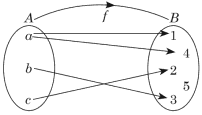
The diagram given below shows that
Image
Choose the correct answer
If $\theta$ is the angle between two vectors $\vec{\text{a}}\ \text{and}\ \vec{\text{b}},\ \text{then}\ \vec{\text{a}}\cdot\vec{\text{b}}\geq0$ only when,
  1. $0<\theta<\frac{\pi}{2}$
  2. $0\leq\theta\leq\frac{\pi}{2}$
  3. $0<\theta<\pi$
  4. $0\leq\theta\leq\pi$​​