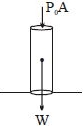
If solid will break under pressure greater than $13\ atm$ and that solid has a specific gravity of $4$ , what is the maximum height of a cylinder made from the solid that can be built at the earth's surface ? (Note: $1\ atm$ = $10^5\ Pa$ .) ......... $m$
A$4$
B$32.5$
C$24$
D$30$
Medium
Download our app for free and get started
D$30$
d $\mathrm{P}_{0} \mathrm{A}+\mathrm{hA} \rho \mathrm{g}=\mathrm{P}_{1} \mathrm{A}$
Experience the future of education. Simply download our apps or reach out to us for more information. Let's shape the future of learning together!No signup needed.*
There is a metal cube inside a block of ice which is floating on the surface of water. The ice melts completely and metal falls in the water. Water level in the container
A container of large uniform cross-sectional area $A$ is resting on a horizontal surface holds two immiscible, non-viscous and incompressible liquids of densities $d$ and $2d$ each of height $\frac{H}{2}$ as shown. The lower density of liquid is open to atmosphere. A small hole is made on the wall of container at height $h\left( {h < \frac{H}{2}} \right)$. The initial speed of efflux of the liquid at the hole is
The diagram below shows a hydraulic lift.A force is applied at $side\ 1$ and an output force is generated at $side\ 2$. Which of the following is true?
A stream-lined body falls through air from a height $h$ on the surface of liquid. Let $d$ and $D$ denote the densities of the materials of the body and the liquid respectively. If $D > d$, then the time after which the body will be instantaneously at rest, is
A container of liquid release from the rest, on a smooth inclined plane as shown in the figure. Length of at the inclined plane is sufficient, and assume liquid finally equilibrium. Finally liquid surface makes an angle with horizontal ...... $^o$
During a blood transfusion a needle is inserted in a vein where the gauge pressure is $2000\,Pa$. At what height must the blood container be placed so that blood may just enter the vein ?
[Density of blood $= 1.06 \times 10^3\,kgm^{-3}$ ].
There is a $1$ $mm $ thick layer of glycerine between a flat plate of area $100$ $cm^2$ $\&$ a big fixed plate. If the coefficient of viscosity of glycerine is $1.0$ $kg/m^{-s}$ then ....... $N$ force is required to move the plate with a velocity of $7$ $cm/s$ ?
$Assertion :$ For Reynold’s number $Re > 2000$, the flow of fluid is turbulent.
$Reason :$ Inertial forces are dominant compared to the viscous forces at such high Reynold’s numbers.