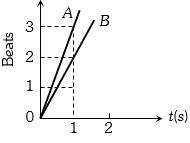
Two tuning forks $P$ and $Q$ are vibrated together. The number of beats produced are represented by the straight line $OA$ in the following graph. After loading $Q$ with wax again these are vibrated together and the beats produced are represented by the line $OB.$ If the frequency of $P$ is $341Hz,$ the frequency of $Q$ will be ... $ Hz$
Medium
Download our app for free and get started
(c)${n_Q} = 341 \pm 3 = 344Hz$ or $338Hz$
on waxing $Q,$ the number of beats decreases hence ${n_Q} = 344Hz$
on waxing $Q,$ the number of beats decreases hence ${n_Q} = 344Hz$

Download our appand get started for free
Experience the future of education. Simply download our apps or reach out to us for more information. Let's shape the future of learning together!No signup needed.*
Similar Questions
- 1A man is standing on a railway platform listening to the whistle of an engine that passes the man at constant speed without stopping. If the engine passes the man at time ${t_0}$. How does the frequency $f$ of the whistle as heard by the man changes with timeView Solution
- 2The equation of a wave travelling on a string is $y = 4\sin \frac{\pi }{2}\left( {8t - \frac{x}{8}} \right)$. If $x$ and $y$ are in $cm,$ then velocity of wave isView Solution
- 3The percentage increase in the speed of transverse waves produced in a stretched string if the tension is increased by $4\, \%$, will be ......... $\%$View Solution
- 4The displacement at a point due to two waves are $y_1=4 \sin (500 \pi t)$ and $y_2=2 \sin (506 \pi t)$. The result due to their superposition will beView Solution
- 5The temperature at which the speed of sound in air becomes double of its value at ${0^o}C$ is ...... $K$View Solution
- 6On a long horizontally moving belt, a child runs to and fro with a speed $9\, km\, h^{-1}$ (with respect to the belt) between his father and mother located $50\, m$ apart on the moving belt. The belt moves with a speed of $4\, km\, h^{-1}$. For an observer on a stationary platform, the speed of the child running in the direction of motion of the belt is ..... $km\,h^{-1}$View Solution
- 7A rope of length $L$ and mass $M$ hangs freely from the ceiling. If the time taken by a transverse wave to travel from the bottom to the top of the rope is $T$, then time to cover first half length isView Solution
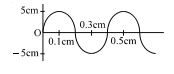
- 8Figure shown the shape of part of a long string in which transverse waves are produced by attaching one end of the string to tuning fork of frequency $250 Hz$. What is the velocity of the waves .... $ms^{-1}$ ?View Solution
- 9A train whistling at constant frequency is moving towards a station at a constant speed $V$ . The train goes past a stationary observer on the station. The frequency $n'$ of the sound as heard by the observer is plotted as a function of time $t$ (Fig.) . Identify the expected curveView Solution
- 10$16$ tunning forks are arranged in the order of increasing frequencies. Any two successive forks give $8$ beats per sec when sounded together. If the frequency of the last fork is twice the first, then the frequency of the first fork isView Solution